

What's Happening?
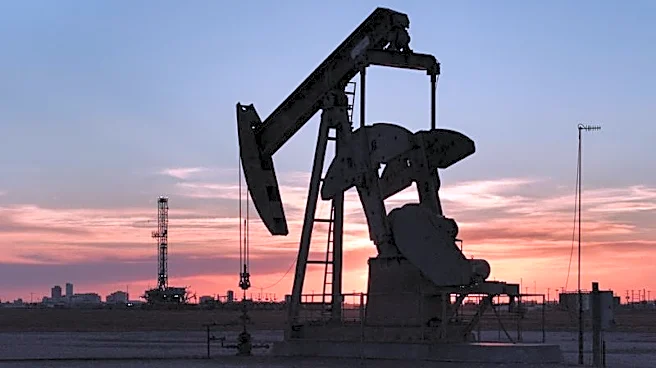
Chevron's stock has seen a significant increase, returning 39.3% over the past twelve months, outperforming the S&P 500's 9.7% gain. This surge in profits and share price is largely attributed to a global fuel shortage and reduced export capacity stemming
from ongoing conflicts, as stated by Chevron management on October 30, 2026. The company has been selling into a market where approximately 10% of global refining capacity is offline. Crude oil prices experienced wide fluctuations in fiscal Q3 2026, ranging from $68 to $132 a barrel. Chevron's total revenue jumped significantly, with a 51.4% rise in fiscal Q2 2026 and 35.4% in fiscal Q3, following a modest 3.2% growth in Q1. The company's operating margin reached 14.6% over the twelve months to September 2026, an increase from 8.1% a year earlier. Chevron's downstream business, which includes its refineries, generated $142 billion in fiscal 2025, surpassing its upstream business which brought in $88.4 billion.
Why It's Important?
The substantial gain in Chevron's stock highlights the profound impact of global geopolitical events and supply chain disruptions on the energy sector and the broader U.S. economy. The global fuel shortage and reduced export capacity have created a favorable market for oil and gas companies like Chevron, leading to increased profitability. This situation directly affects U.S. consumers through fluctuating fuel prices and impacts the financial performance of energy-related investments. The company's ability to achieve record quarterly U.S. crude throughput, partly due to added capacity at refineries such as Pasadena, demonstrates its strategic efforts to capitalize on current market conditions. However, the market's assumption that some of today's profit may not last suggests a cautious outlook on the long-term sustainability of these elevated earnings, indicating potential volatility for investors and the energy market.
What's Next?
Chevron management anticipates that refining margins will remain elevated in the short term due to the ongoing supply squeeze. However, they expressed more caution regarding the longer-term outlook for chemicals, suggesting that markets could return to oversupply once global flows normalize, unless capacity closures or project deferrals occur. The current stock valuation, trading at 15.0 times its past year's earnings compared to 21.5 for the S&P 500, implies that investors are already factoring in a potential decrease in future profits. This suggests that while the immediate future looks strong for Chevron, the company and its investors will need to closely monitor global conflicts, refining capacity, and overall market demand to anticipate shifts in profitability and stock performance.
Beyond the Headlines
The current scenario underscores the delicate balance between global energy supply and demand, heavily influenced by geopolitical stability and infrastructure capacity. The significant profits reaped by Chevron during this period of global shortage raise questions about energy security and the resilience of supply chains in the face of international conflicts. It also highlights the strategic importance of refining capacity and the potential for domestic infrastructure improvements, like those at Chevron's Pasadena refinery, to mitigate external shocks. The cyclical nature of the oil and gas industry, as evidenced by Chevron's operating margin fluctuations since 2022, suggests that periods of high profitability can be followed by downturns, emphasizing the need for long-term strategic planning and diversification within the energy sector.