



What's Happening?
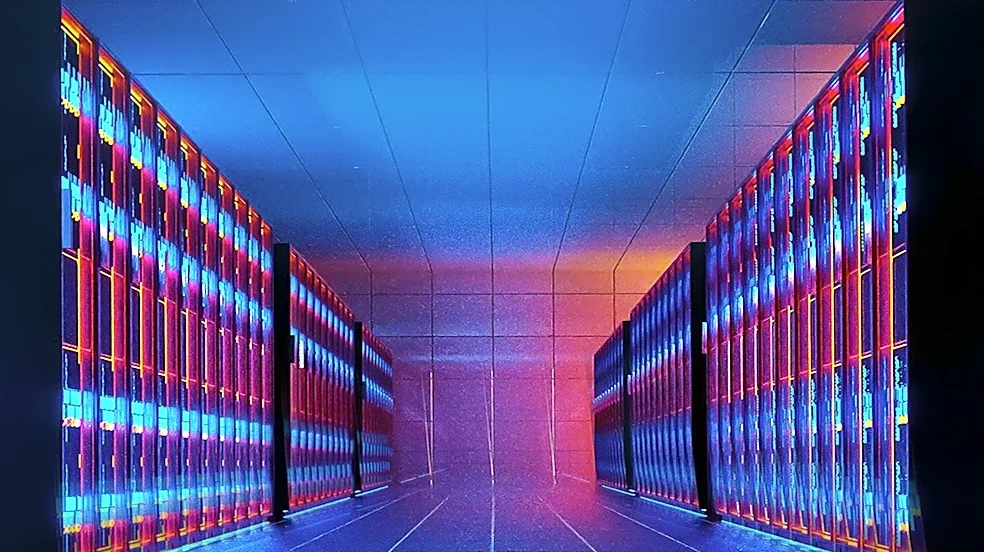
Meta is significantly expanding its Prometheus supercluster in New Albany, Ohio, with plans to grow it to approximately one million Nvidia GPUs. The first phase of this gigawatt-scale cluster is already complete and has been utilized to train Meta's Muse
family of AI models, including the Muse Wonder models. This site, which was a conventional data center two years ago, now runs hundreds of thousands of Nvidia GPUs across multiple buildings. Meta's engineering blog post detailed that Prometheus will eventually comprise one million distributed GPUs functioning in lockstep. The company is employing three generations of Nvidia racks, including the GB200 NVL72, GB300 NVL72, and the upcoming Vera Rubin NVL72, connected by miles of fiber optics. Meta has also made significant progress in improving the reliability of the cluster, reducing interruptions by 99% from a peak of nearly 1,000 events per 8,000 GPUs daily in mid-2025.
Why It's Important?
The massive expansion of Meta's Prometheus supercluster underscores the escalating demand for computational power in advanced AI development. A cluster of one million GPUs represents an unprecedented scale of AI training infrastructure, highlighting Meta's commitment to leading in the AI race. This investment is crucial for training increasingly complex AI models like the Muse family, which require immense processing capabilities. The challenges Meta has overcome in managing power swings and ensuring reliability at this scale provide valuable insights for the broader AI industry, demonstrating the engineering feats required for such large-scale deployments. The lessons learned from Prometheus will also inform the design of Meta's next supercluster, Hyperion, in Louisiana, indicating a continuous push towards more efficient and powerful AI infrastructure. This development has significant implications for the future of AI research and application, potentially accelerating breakthroughs in various fields.
What's Next?
Meta will continue to expand the Prometheus supercluster towards its goal of one million GPUs, integrating newer Nvidia technologies like the Vera Rubin NVL72 racks. The company will apply the engineering lessons from Prometheus to the development of its next supercluster, Hyperion, aiming for even greater efficiency and reliability. Ongoing efforts will focus on further reducing interruptions and optimizing GPU utilization to achieve its goal of 100,000 GPU hours on average between interruptions. This continuous investment in AI infrastructure suggests that Meta will likely introduce more advanced AI models and applications in the future, leveraging its enhanced computational capabilities. The company's commitment to matching its energy consumption with new clean and renewable energy, despite leaving the RE100 pact, indicates a continued focus on sustainability in its large-scale data center operations.
Beyond the Headlines
The sheer scale of Meta's Prometheus supercluster raises profound questions about the future of AI development and its environmental impact. The demand for gigawatt-scale power and the associated energy consumption for such facilities will necessitate significant advancements in renewable energy sources and energy efficiency. The technical challenges of managing power swings of tens of megawatts and ensuring the reliability of millions of interconnected GPUs highlight the complexity of building and operating next-generation AI infrastructure. This massive investment also reflects the strategic importance of owning and controlling AI compute resources, potentially creating a competitive advantage for companies that can afford such large-scale deployments. The development of these superclusters could also lead to new innovations in hardware design, cooling technologies, and distributed computing, benefiting the broader tech industry.