





What's Happening?
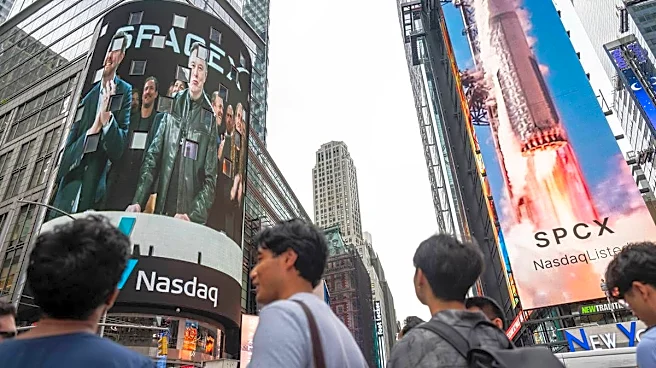
SpaceX, led by Elon Musk, recently made headlines with its initial public offering (IPO) on June 12, which set a Wall Street record as the highest-valued IPO in financial history, raising over $75 billion. The company's public valuation now hovers around
$2 trillion, making it one of the world's largest-traded companies. SpaceX's IPO was notable for its inclusion of xAI, marking the first time an AI giant has entered the public market. The IPO attracted significant attention from retail investors, with 30% of shares allocated to them, a larger portion than usual. Despite the initial success, SpaceX's stock has experienced volatility, with prices fluctuating significantly since the IPO. The company's financials reveal that while it generated over $18.5 billion in revenue in 2025, it still operated at a loss due to high expenditures on AI projects and aerospace equipment.
Why It's Important?
The SpaceX IPO is significant for several reasons. It highlights the growing interest and investment in AI and aerospace technologies, sectors that are expected to drive future economic growth. The IPO's success underscores the market's appetite for high-tech ventures, despite the inherent risks and volatility. For retail investors, the large allocation of shares represents both an opportunity and a risk, as they are exposed to the stock's fluctuations. The inclusion of SpaceX in major indices like the Nasdaq-100 means that many retirement accounts will automatically include SpaceX stock, potentially impacting millions of investors. Additionally, the IPO sets a precedent for other tech companies considering going public, influencing their strategies and timing.
What's Next?
SpaceX's inclusion in the Nasdaq-100 is set to occur before July 7, which will require index funds to purchase its shares, further integrating the stock into retirement accounts. This move has sparked debate, with some critics, including Senator Elizabeth Warren, calling for an investigation into the potential risks for everyday investors. The IPO's success may also influence other tech companies, such as OpenAI, which is reportedly reconsidering its own IPO plans in light of SpaceX's market performance. As SpaceX continues to navigate the public market, its financial performance and strategic decisions will be closely watched by investors and industry analysts.
Beyond the Headlines
The SpaceX IPO also raises questions about the influence of high-profile tech leaders like Elon Musk on market dynamics and public perception. Musk's significant control over SpaceX, through super-voting shares, highlights the power dynamics within tech companies and the potential implications for corporate governance. The IPO's impact on retail investors and retirement accounts also points to broader discussions about financial literacy and the responsibilities of financial institutions in managing public investments. Furthermore, the IPO's success may encourage other tech companies to pursue public offerings, potentially reshaping the landscape of the tech industry.