







What's Happening?
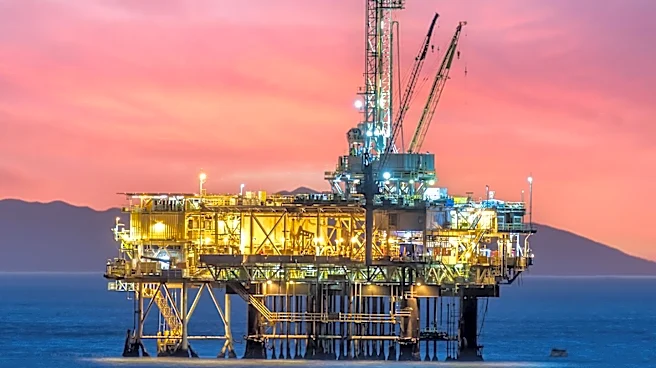
TotalEnergies and Mistral have initiated a three-year, over $115 million artificial intelligence (AI) program aimed at developing advanced models for oil and gas exploration, reservoir characterization, and field development. This partnership will combine
TotalEnergies' extensive subsurface data and nearly a century of geoscience and reservoir engineering expertise with Mistral's AI capabilities, including agentic AI. The collaboration seeks to create AI models capable of integrating and interpreting large volumes of subsurface data to generate multiple development scenarios for exploration opportunities. The technology will also be utilized to optimize development and potentially extend the productive life of existing oil and gas projects. A joint scientific laboratory will be established, bringing together TotalEnergies' subsurface specialists and Mistral's AI researchers and engineers to develop proprietary tools tailored for TotalEnergies' upstream operations. This program expands an existing collaboration between the two entities, reflecting TotalEnergies' increasing adoption of AI across its technical and industrial applications.
Why It's Important?
This substantial investment in AI for oil and gas exploration by TotalEnergies and Mistral holds significant implications for the U.S. energy sector and global energy markets. By leveraging AI, the companies aim to enhance the efficiency and accuracy of discovering new oil and gas reserves, optimize extraction processes, and extend the lifespan of existing projects. This could lead to more cost-effective production, potentially influencing global oil and gas prices and the competitiveness of U.S. energy companies. The development of advanced AI models for interpreting complex subsurface data could reduce the risks associated with exploration, leading to higher success rates and more efficient capital allocation. For the U.S., a more efficient domestic oil and gas industry could bolster energy independence and security. However, it also raises questions about the long-term commitment to fossil fuels amidst global efforts to transition to renewable energy. The program's success could also spur further AI adoption across the broader energy industry, impacting technology providers, data scientists, and engineering firms. The collaboration highlights the growing trend of integrating cutting-edge technology into traditional industries to unlock new efficiencies and value.
What's Next?
Over the next three years, TotalEnergies and Mistral will focus on developing and implementing the advanced AI models and proprietary tools within their joint scientific laboratory. The immediate next steps involve the integration of TotalEnergies' vast geoscience data with Mistral's AI expertise to begin building these sophisticated models. The success of this program will be measured by its ability to generate more accurate exploration scenarios, optimize reservoir characterization, and improve the efficiency of field development. If successful, the technology could be scaled across TotalEnergies' global operations, potentially setting a new standard for AI integration in the oil and gas industry. Other major energy companies will likely observe the outcomes of this collaboration, potentially leading to similar AI initiatives across the sector. The program's long-term impact could include a reduction in exploration costs, an increase in recoverable reserves, and a more data-driven approach to energy production. Additionally, the development of specialized AI tools could create new intellectual property and technological advancements within the energy tech landscape.
Beyond the Headlines
The partnership between TotalEnergies and Mistral to infuse AI into oil and gas exploration presents deeper implications for the energy industry and society. Ethically, the continued optimization of fossil fuel extraction through advanced AI raises questions about the pace of the energy transition and the commitment to climate goals. While AI can make existing operations more efficient, it also prolongs reliance on carbon-intensive resources. Environmentally, more precise exploration and extraction could theoretically reduce the footprint of operations, but the fundamental impact of burning fossil fuels remains. Culturally, this collaboration underscores the pervasive influence of AI, demonstrating its application even in highly traditional and capital-intensive sectors. It highlights a strategic pivot where even industries facing pressure to decarbonize are investing heavily in technology to maximize current assets. Legally, the development and deployment of proprietary AI tools for such critical infrastructure could lead to new regulatory considerations regarding data privacy, algorithmic bias in geological interpretations, and intellectual property rights in AI-generated insights. The long-term societal impact could be a more technologically advanced, yet still fossil-fuel-dependent, global energy landscape, creating a complex interplay between innovation, environmental responsibility, and economic imperatives.