







What's Happening?
Gartner, a leading research and advisory company, projects that by 2029, agentic AI will autonomously resolve 80% of common customer service issues without human intervention. This forecast highlights a significant shift in help desk automation, moving
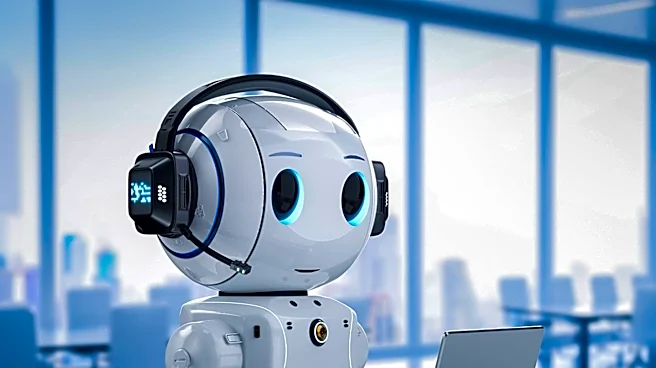
beyond rules-based routing and AI-assisted suggestions to full resolution. Agentic AI systems are designed to understand requests in natural language, find relevant answers from knowledge bases, and take direct action within connected systems, such as resetting passwords or provisioning access. Unlike traditional chatbots that primarily answer or route queries, agentic AI aims to complete tasks end-to-end. Companies like Enjo and Moveworks are at the forefront of this technology, offering solutions that integrate deeply into existing IT Service Management (ITSM) environments. The industry is seeing a rapid repositioning of vendors around the term 'agentic' due to this projected growth, with many claiming agentic capabilities, though Gartner estimates only about 130 out of thousands of vendors truly offer substantial agentic resolution.
Why It's Important?
This projection signifies a major transformation in how U.S. businesses will manage customer service and internal IT support. The autonomous resolution of 80% of common issues by agentic AI could lead to substantial cost savings, increased efficiency, and improved customer satisfaction. Businesses stand to gain by reducing the workload on human agents, allowing them to focus on more complex or sensitive issues. This shift will also impact the labor market, potentially reducing demand for entry-level customer service and IT support roles focused on routine tasks. Companies that adopt agentic AI early and effectively could gain a competitive advantage through faster response times and higher resolution rates. Conversely, businesses that fail to adapt may struggle with outdated support systems, leading to higher operational costs and diminished customer experiences. The integration of agentic AI into existing enterprise systems like ServiceNow, Jira, and Okta will be crucial for seamless adoption and maximizing benefits.
What's Next?
In the coming years, businesses will likely increase their investment in agentic AI solutions to meet Gartner's projected autonomous resolution rates. This will involve evaluating and implementing tools that offer true end-to-end resolution rather than just AI-assisted suggestions. Vendors will continue to refine their agentic AI offerings, focusing on improved natural language processing, broader integration capabilities with various enterprise systems, and enhanced governance features to ensure safety and compliance. Companies will also need to develop strategies for upskilling their human workforce, transitioning them from routine task execution to managing AI systems, handling escalated issues, and focusing on customer relationships. The market will likely see further consolidation as larger tech companies acquire promising agentic AI startups, as exemplified by ServiceNow's acquisition of Moveworks. Additionally, there will be a growing emphasis on robust governance, including guardrails, role-based access, and audit trails, to ensure the responsible deployment of these powerful AI systems.
Beyond the Headlines
The widespread adoption of agentic AI raises deeper implications beyond operational efficiency. Ethically, the increasing autonomy of AI in customer interactions necessitates careful consideration of transparency and accountability. Customers may interact with AI without realizing it, leading to potential issues if the AI makes errors or handles sensitive information. Legally, frameworks may need to evolve to address liability when AI systems make decisions or take actions that result in negative outcomes. Culturally, the shift could redefine the nature of work, emphasizing human skills like empathy, critical thinking, and complex problem-solving, which AI currently struggles to replicate. There's also the potential for a 'digital divide' where businesses with the resources to implement advanced AI gain significant advantages, further widening the gap with smaller enterprises. The long-term societal impact on employment and the human-AI collaboration model will be a critical area of ongoing development and discussion.