






What's Happening?
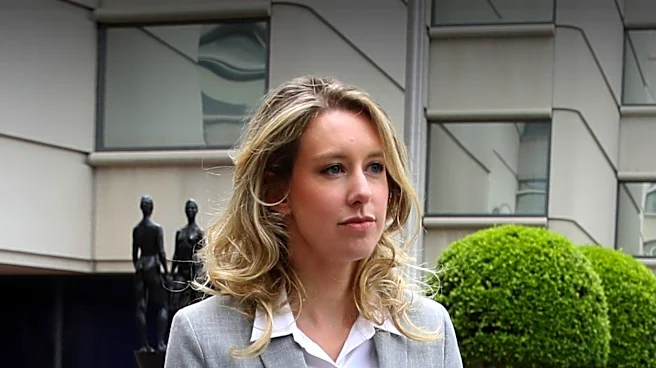
Nathan Fielder and Lance Oppenheim's new documentary, 'You Can See Everything,' about Elizabeth Holmes, the disgraced Theranos founder, is redefining the documentary genre. The film, which was made in secret and recently revealed through a surprise trailer,
offers unprecedented access to Holmes and her family in the days leading up to her federal prison sentence in 2023. Holmes is shown having her likeness captured and scanned to be reproduced via video, hologram, and artificial intelligence for a new healthcare startup she and her partner, William 'Billy' Evans, are launching. The documentary is described as gripping and shocking, with Fielder's signature style of awkwardness and meta-narratives, exploring the complexities of Holmes's character and the nature of truth.
Why It's Important?
This documentary is significant for its innovative approach to filmmaking and its potential impact on how audiences perceive truth and reality in media. By granting such intimate access to a controversial public figure like Elizabeth Holmes, the film challenges traditional documentary ethics and narrative structures. Fielder's involvement, known for blurring lines between reality and fiction in his previous works, suggests a meta-commentary on the documentary process itself. The film's exploration of Holmes's decision to create AI versions of herself for future business ventures also highlights the growing intersection of technology, public image, and legal consequences, raising questions about identity and representation in the digital age. Its critical reception, with some calling it 'the movie of the year,' indicates a potential shift in what constitutes a groundbreaking documentary.
What's Next?
As 'You Can See Everything' opens in theaters across the U.S., audiences will have the opportunity to engage with its unique narrative and stylistic choices. The film's critical acclaim and the buzz surrounding its unconventional approach could influence future documentary filmmaking, encouraging more experimental and self-aware storytelling. The discussions it sparks about Elizabeth Holmes's character, the nature of deception, and the role of media in shaping public perception are likely to continue. Furthermore, the film's exploration of AI and digital identity could prompt broader conversations about the ethical implications of creating and utilizing digital replicas of individuals, especially those with complex public histories.
Beyond the Headlines
Beyond its immediate impact as a film, 'You Can See Everything' delves into profound philosophical questions about truth, perception, and the human condition. Fielder's quest to understand Holmes, whom he compares to a magician and potentially 'the most manipulative person who has ever lived,' forces viewers to confront the subjective nature of reality. The film's visual style, often employing extreme close-ups and showing the film crew, intentionally blurs the lines between observation and participation, challenging the audience to question what they are seeing and how they are being influenced. This meta-narrative approach, combined with Holmes's own efforts to control her image through AI, creates a complex tapestry that reflects on the power of storytelling, the construction of public personas, and the elusive nature of authenticity in a world increasingly mediated by technology.