





What's Happening?
The Chicagoland Accordion Academy is actively working to rekindle interest in the accordion, an instrument that experienced a significant decline in popularity after its peak in the U.S. from the 1930s to the 1950s. Academy founder and director Mary Ann
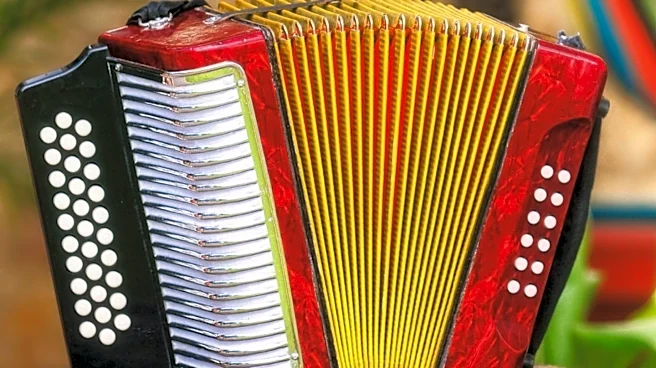
Covone attributes the instrument's fall from grace to the rise of rock and roll music. Despite its association with polka, lifelong fan Daiva Kisielius highlights the accordion's versatility, noting its ability to mimic sounds of violins, clarinets, and organs, and its suitability for various genres from tango to waltz. The instrument, which originated in ancient China, produces sound through bellows that pump air through reeds. Professor emeritus Joan Sommers, who established the accordion program at the University of Missouri–Kansas City over 50 years ago, emphasizes the instrument's long history and evolutionary changes.
Why It's Important?
The effort by the Chicagoland Accordion Academy to revive the accordion's popularity is important for cultural preservation and musical diversity in the U.S. The decline of the accordion reflects broader shifts in musical tastes and the dominance of certain genres, potentially leading to the marginalization of unique musical traditions. By promoting the accordion, the academy aims to introduce a new generation to an instrument with rich historical and expressive capabilities, thereby enriching the American musical landscape. This initiative could also foster a greater appreciation for diverse musical forms beyond mainstream genres. The resurgence of interest, as noted by Covone, suggests a potential shift in cultural trends, where unique and 'old-fashioned' instruments might find new relevance and appeal among younger audiences, as exemplified by students like Ricky and Paulina.
What's Next?
Mary Ann Covone, as head of the Chicagoland Accordion Academy, is optimistic about a resurgence in the accordion's popularity, noting that 'closet accordion players are coming out.' The academy's focus will likely continue to be on education and outreach, demonstrating the instrument's versatility and dispelling its narrow association with polka music. Future initiatives might include more public performances, workshops, and collaborations with other musical institutions to showcase the accordion's broad appeal. The success of these efforts will depend on attracting new students, particularly younger individuals, and integrating the accordion into contemporary musical contexts. The academy's mission could inspire similar efforts for other niche instruments, contributing to a broader movement of musical heritage preservation and innovation.
Beyond the Headlines
Beyond its immediate musical impact, the accordion's journey from widespread popularity to relative obscurity and potential resurgence offers insights into the cyclical nature of cultural trends and the influence of popular culture on artistic forms. The instrument's decline due to rock and roll illustrates how dominant cultural shifts can rapidly alter public perception and engagement with traditional arts. Its potential revival, however, suggests a growing appreciation for authenticity, unique sounds, and a desire to explore musical expressions beyond the mainstream. This phenomenon could reflect a broader societal trend towards valuing diverse cultural heritage and seeking out less conventional forms of artistic engagement, challenging the notion that 'old-fashioned' automatically equates to irrelevant. The personal connection players feel to the instrument, as described by Covone, also highlights the profound emotional and identity-forming role that musical instruments can play.