








What's Happening?
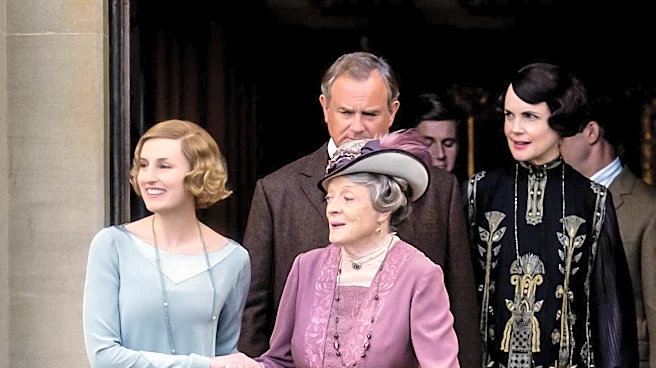
A reviewer shared a personal reflection on watching 'Downton Abbey: The Grand Finale,' describing an unexpected emotional reaction to the film. The reviewer, seeking solace amidst political and social upheaval, found themselves in tears by the movie's
conclusion. The primary storyline that evoked this strong response was that of Robert Crawley, the Earl of Grantham, as he grappled with relinquishing his lifelong role and allowing his daughter, Lady Mary, to take control of Downton. The reviewer noted that Crawley's struggle was not merely about giving up responsibility but about surrendering his identity and the familiar structure of his life, which resonated deeply on a human level.
Why It's Important?
This personal account highlights the enduring emotional power of storytelling and how fictional narratives can deeply connect with universal human experiences. The reviewer's experience underscores how themes of identity, change, and the process of letting go, as depicted in 'Downton Abbey,' can evoke profound emotional responses in audiences. It demonstrates the capacity of well-crafted narratives to provide solace and reflection, even in times of personal or societal turmoil. The emotional impact described suggests that the film successfully tapped into fundamental aspects of the human condition, making it relatable beyond its specific historical and social setting.
What's Next?
While the article is a retrospective review of 'Downton Abbey: The Grand Finale,' its discussion of the film's emotional resonance suggests that such themes continue to be relevant and impactful for audiences. The enduring popularity of the 'Downton Abbey' franchise, even years after its initial run, indicates a continued appetite for stories that explore themes of tradition, change, and personal evolution within a historical context. This could encourage creators to develop similar narratives that delve into the complexities of human identity and societal shifts, knowing there is an audience receptive to such profound storytelling.
Beyond the Headlines
The reviewer's experience touches upon the deeper psychological role that media consumption can play in individuals' lives. In moments of societal unrest or personal uncertainty, familiar and emotionally resonant stories can serve as a form of catharsis or a means of processing complex feelings. The narrative of Robert Crawley's struggle with identity loss can be seen as a metaphor for broader societal changes, where individuals and institutions must adapt to new realities. This reflection suggests that entertainment, beyond mere escapism, can offer valuable insights into the human condition and provide a space for emotional processing and understanding.