






What's Happening?
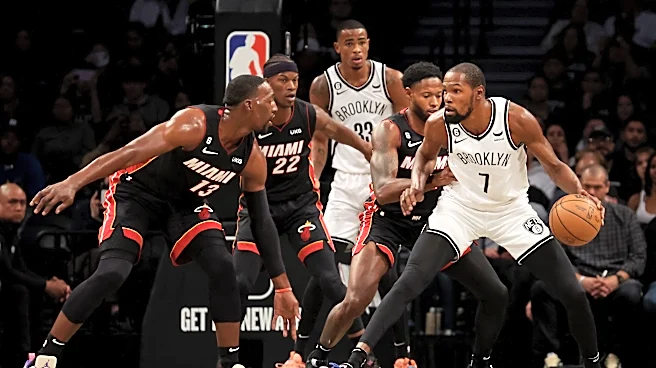
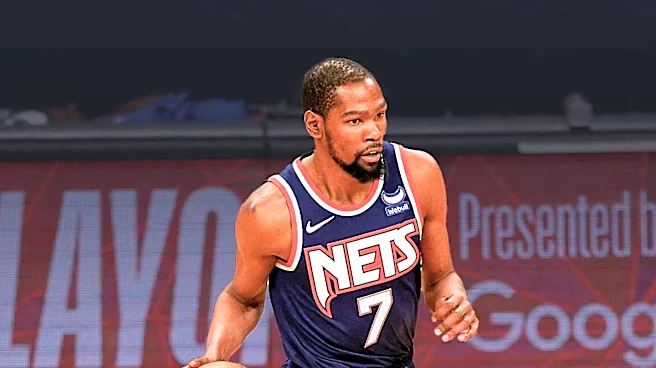
Kevin Durant has stated that the 2021-22 Brooklyn Nets roster was the most accomplished team he has ever played on, at least 'on paper.' During an appearance on Boardroom, Durant specifically cited the presence of Kyrie Irving, James Harden, Blake Griffin,
LaMarcus Aldridge, Paul Millsap, and Patty Mills as evidence of the team's individual talent and accolades. His assessment was based on the collective achievements of these players prior to their arrival in Brooklyn. Despite this impressive collection of talent, the team, often referred to as a 'superteam,' ultimately failed to reach the NBA Finals due to a series of injuries and other disruptions that hampered their championship aspirations. Durant, a two-time Finals MVP, contrasted this with his experience with the Golden State Warriors, which he considers the best actual team of his career, particularly the 2018-19 roster.
Why It's Important?
Kevin Durant's reflection on the 2021-22 Brooklyn Nets highlights a critical distinction between theoretical talent and actual team success in professional sports. The Nets' failure to achieve their championship goals, despite an abundance of 'on paper' talent, underscores the complex interplay of team chemistry, health, and execution that is necessary for victory. This perspective is significant for understanding the challenges of building 'superteams' in the NBA, where the aggregation of individual stars does not automatically translate into a cohesive and winning unit. For other franchises, this serves as a cautionary tale, emphasizing that roster construction must go beyond simply acquiring big names. It also reinforces the idea that sustained success often comes from a well-integrated team with strong leadership and resilience, rather than just a collection of individual accolades. The financial implications of assembling such a high-profile roster without achieving the ultimate goal also raise questions about resource allocation in professional sports.
What's Next?
While Kevin Durant has moved on from the Brooklyn Nets, his comments will likely continue to fuel discussions about the nature of 'superteams' and the factors that contribute to championship success in the NBA. For current and future NBA executives, Durant's insights could influence how they approach roster building, potentially leading to a greater emphasis on team fit, player health, and long-term sustainability over simply acquiring the most individually talented players. The Nets, now under a different strategic direction, will continue to navigate the aftermath of that era, learning from past experiences as they aim to build a new competitive roster. The league as a whole may see a continued evolution in team-building philosophies, with a potential shift away from purely star-driven models towards more balanced and resilient team compositions, especially given the increasing financial stakes and competitive landscape.
Beyond the Headlines
Kevin Durant's distinction between a team being great 'on paper' versus being a great 'actual team' delves into the philosophical core of sports team dynamics. It highlights that success is not merely an arithmetic sum of individual talents but a complex synergy of various elements, including leadership, adaptability, mental fortitude, and a shared vision. The 'on paper' concept often overlooks the human element—how personalities mesh, how players sacrifice individual glory for collective good, and how a team responds to adversity. This perspective has broader implications beyond basketball, resonating in any field where collective achievement is paramount. It suggests that while talent acquisition is crucial, the cultivation of a cohesive and resilient unit is equally, if not more, vital for sustained success. The Nets' experience serves as a powerful case study in the limitations of purely talent-centric approaches, prompting a deeper examination of organizational culture and strategic leadership in high-stakes environments.