



What's Happening?
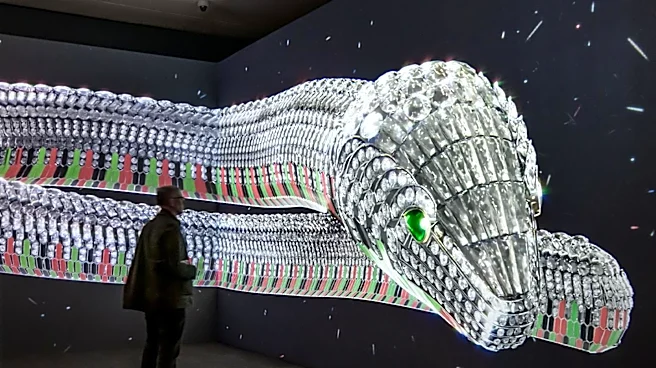
Internationally renowned media artist Refik Anadol, recognized as the 'Artist of the AI Age' by TIME, will present his large-scale, multisensory installation, 'Machine Hallucinations: LNM Variations,' at the Notre Dame Arts Biennial. The exhibition will be
installed in the Forum in Jenkins and Nanovic Halls from January 29 to February 12, 2027. Anadol will also deliver a public artist talk on January 29, followed by an opening reception. Admission to both the exhibition and the event is free and open to the public. Anadol's work explores the intersection of human and machine creativity, utilizing data as primary material and neural networks as collaborators to create visualizations of digitized memories. This exhibition is part of an expanding collection of works crafted using the Large Nature Model (LNM), the world's first open-access, generative AI system dedicated to nature, developed by Refik Anadol Studio.
Why It's Important?
This exhibition at the University of Notre Dame highlights the growing integration of artificial intelligence into the arts and academic discourse. Anadol's work challenges conventional perceptions of AI, demonstrating its potential to expand human imagination and creativity beyond automation. The Large Nature Model (LNM), which powers the exhibition, is significant for its ethical data sourcing from institutions like the Smithsonian and National Geographic, and its sustainable computational practices. By recognizing relationships between species, habitats, and environmental factors, the LNM makes abstract environmental conservation tangible, encouraging collective responsibility. The presence of such a prominent AI artist in an academic setting like Notre Dame underscores the university's commitment to interdisciplinary exploration, bringing together arts, humanities, and AI to push boundaries of discovery and enrich human experience.
What's Next?
Following its opening on January 29, 2027, 'Machine Hallucinations: LNM Variations' will be on view until February 12, 2027, offering the public an opportunity to engage with cutting-edge AI art. The Notre Dame Arts Biennial, running from January through June 2027, will feature over 100 public events, including exhibitions, performances, and workshops, with most events being free. This event could inspire further interdisciplinary collaborations between artists, data scientists, and researchers, fostering new approaches to understanding and interacting with both technology and nature. The exhibition's focus on environmental themes through AI may also spark broader discussions on how technology can contribute to ecological awareness and conservation efforts.
Beyond the Headlines
Anadol's work delves into the ethical and philosophical implications of AI in creative processes. By using machine intelligence to 'learn' from nature's complexity, the exhibition prompts reflection on the relationship between ecological memory, technology, and human imagination. The concept of 'symbiosis,' the biennial's theme, is deeply embedded in Anadol's artistic vision, exploring how humans and machines can co-create and reveal new perspectives on our shared world. This installation at a Catholic research university adds a unique layer of meaning, potentially prompting inquiries into the spiritual and ethical dimensions of AI and its role in understanding the natural world. It also highlights the evolving role of art in public spaces, transforming academic environments into dynamic platforms for technological and artistic innovation.