







What's Happening?
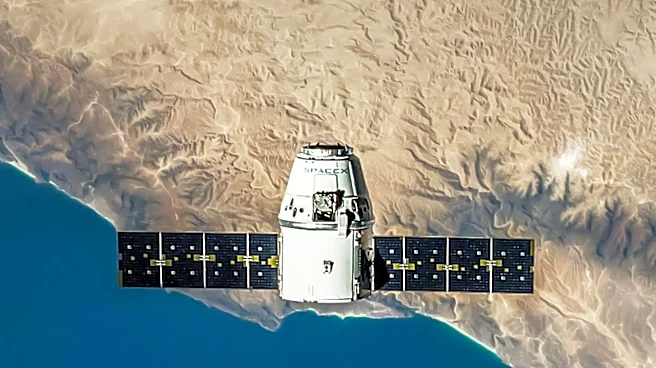
Nvidia has announced a partnership with SpaceX to develop the compute payload for the Starmind AI1 satellite, marking a significant expansion into space-based AI computing. This collaboration aims to leverage Nvidia's advanced hardware to run AI workloads
from orbit, with SpaceX planning to scale this initiative to potentially one million AI satellites. The partnership underscores SpaceX's commitment to using Nvidia's GPUs, as stated by SpaceX CEO Elon Musk, who praised the Vera Rubin architecture. This move is part of Nvidia's broader strategy to extend its AI computing capabilities beyond Earth, addressing the limitations faced by terrestrial data centers in terms of power, land, and cooling. The initiative is expected to capitalize on the advantages of space, such as constant solar energy and natural cooling, to overcome these challenges.
Why It's Important?
The partnership between Nvidia and SpaceX represents a strategic expansion into a potentially lucrative market, with Futurum Research estimating that orbital computing could become a $1 trillion industry by 2030. This development positions Nvidia as a key player in a new frontier of AI computing, potentially reducing its reliance on Earth-based markets and diversifying its growth avenues. For investors, this signals Nvidia's proactive approach to securing its future growth by entering untapped markets. The collaboration also highlights the growing importance of space as a viable platform for advanced computing, driven by decreasing launch costs and the increasing demand for AI processing power. This could have significant implications for industries reliant on data processing and AI, potentially reshaping the landscape of global computing infrastructure.
What's Next?
Nvidia's space chips are expected to ship later this year, with the long-term goal of establishing a one-million-satellite network. This ambitious plan will likely attract attention from other tech companies and investors, potentially leading to further collaborations and innovations in space-based computing. As the project progresses, stakeholders will be watching closely to assess the feasibility and scalability of such a large-scale deployment. Additionally, the success of this initiative could prompt regulatory discussions around space usage and satellite management, as well as potential environmental considerations. The outcome of this partnership could set a precedent for future space-based technology ventures, influencing policy and investment decisions in the tech and aerospace sectors.