




What's Happening?
NFL teams are increasingly choosing to attempt two-point conversions when trailing by eight points in the fourth quarter, rather than kicking an extra point to cut the deficit to seven. This strategic shift is based on mathematical probabilities, aiming
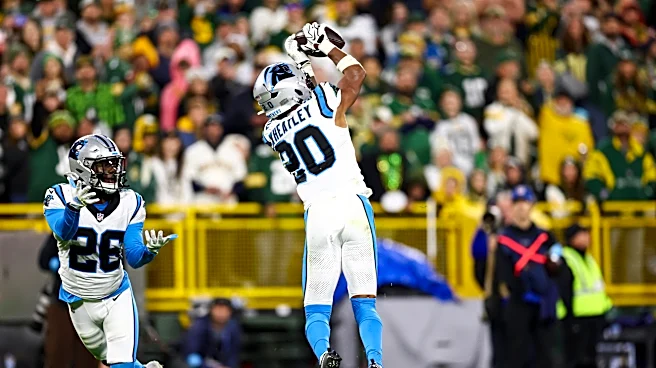
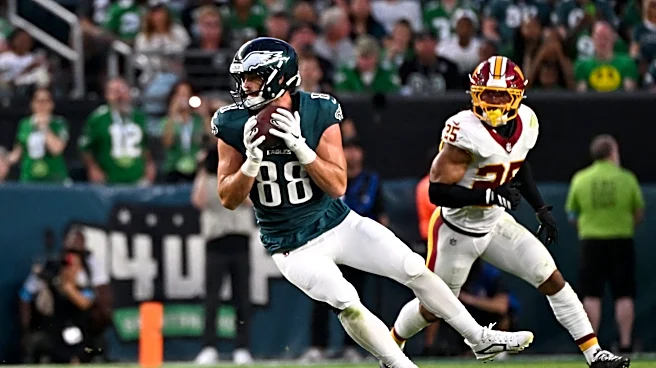
to maximize the chances of winning. Since the extra point was moved back in 2015, teams convert 94.4% of extra points and 48% of two-point tries. While the Carolina Panthers recently missed a two-point conversion in this scenario and lost by eight, the decision reflects a growing trend. The strategy was first employed by Bill Belichick's Cleveland Browns in 1994 and gained modern prominence with Doug Pederson's Philadelphia Eagles in 2018. In the last three seasons, teams have attempted this strategy 26 times in regular season and playoffs, with a record nine times in 2025.
Why It's Important?
This evolving strategy impacts game outcomes and reflects a more analytical approach to football coaching. By opting for a two-point conversion, teams are attempting to secure a tie or a one-point deficit, which statistically offers a higher probability of winning the game, especially when considering the likelihood of overtime. This shift challenges traditional football wisdom and highlights the increasing influence of advanced analytics in sports. It also affects fan engagement and broadcasting, as these critical decisions often lead to intense debate and scrutiny. The success or failure of these attempts can significantly alter a team's playoff chances and overall season trajectory, making it a crucial aspect of modern NFL strategy.
What's Next?
The trend of attempting two-point conversions in specific game situations is likely to continue and potentially become even more prevalent as coaches further embrace analytics. Teams will continue to refine their understanding of when and how to best utilize this strategy, taking into account their specific roster strengths and weaknesses. This could lead to more exciting and unpredictable finishes in NFL games. The league might also observe how these strategic shifts impact scoring and game flow, potentially leading to future rule adjustments or further discussions on the balance between offense and defense. The ongoing debate among fans and analysts about the 'right' decision in these moments will also persist.
Beyond the Headlines
The increasing reliance on statistical probabilities in NFL coaching reflects a broader cultural shift towards data-driven decision-making across various industries. This analytical approach moves beyond gut feelings and traditional practices, emphasizing calculated risks based on empirical evidence. In sports, this can lead to a more dynamic and strategically complex game, where every decision is scrutinized for its mathematical underpinning. It also highlights the competitive pressure on coaches to innovate and adapt, as traditional methods may no longer be sufficient to gain an edge. This trend extends beyond football, influencing strategy in other sports and even business, where data analytics are increasingly used to optimize outcomes.