






What's Happening?
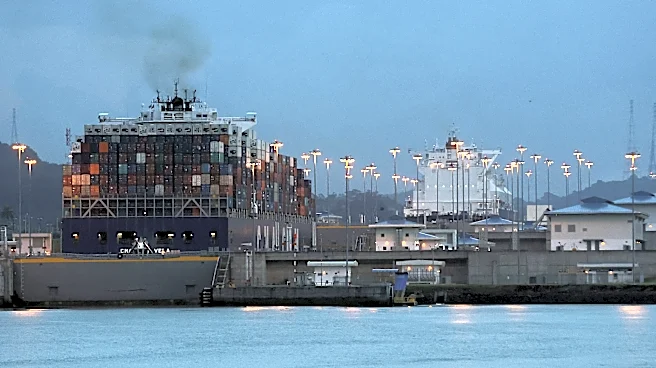
Nike, in partnership with CMA CGM and Vietnamese port operator Gemadept, has launched Vietnam's first fully electric inland waterway barge. Named CMA CGM Electra, the barge connects Nike’s inland cargo consolidation hub in Ho Chi Minh City with the Gemalink
deep-sea terminal in Cai Mep Port. This 112-mile round trip is designed to produce zero direct greenhouse gas emissions. The barge can carry 182 twenty-foot equivalent units (TEUs) and is expected to transport over 50,000 TEUs annually, avoiding approximately 778 tons of carbon dioxide emissions per year compared to road transport. Nike has committed to an eight-year agreement with CMA CGM, utilizing 90 percent of the vessel's capacity for its shipments. The initial investment for the electric barge is roughly double that of a comparable diesel-powered vessel.
Why It's Important?
This initiative marks a significant step in decarbonizing global supply chains, particularly in the logistics sector. For U.S. companies like Nike, which heavily rely on international manufacturing and shipping, investing in sustainable transportation solutions is crucial for meeting environmental goals and responding to consumer demand for eco-friendly products. The launch of Vietnam's first fully electric barge demonstrates a tangible commitment to reducing carbon footprints in a key manufacturing region. This project could serve as a scalable model for other major cargo owners and logistics providers, potentially influencing broader industry adoption of electric vessels and sustainable logistics practices. The higher initial investment cost for electric barges highlights a challenge, but the long-term environmental and brand benefits are significant.
What's Next?
The CMA CGM Electra will operate on its dedicated route, with Nike optimizing its use for shipments between Binh Duong province and the Gemalink terminal. The barge incorporates battery technology from CATL and can be recharged in about four hours using certified renewable electricity from a solar farm at the Gemalink terminal. CMA CGM views this project as a scalable model that can be replicated in other geographies and with other major customers, indicating potential for wider adoption of electric barges. CMA CGM also plans to launch a separate electric and hybrid inland barge on France’s Fos-Lyon corridor by 2028. Nike will continue its broader strategy of reducing emissions across its value chain, focusing on transportation, materials, manufacturing, and its own operations.
Beyond the Headlines
This development signifies a broader shift towards sustainable logistics and the integration of renewable energy into global supply chains. The dedicated charging infrastructure powered by a solar farm at Gemalink terminal exemplifies a holistic approach to decarbonization, moving beyond just electric vehicles to encompass their energy sources. The project's scalability suggests a potential for significant environmental impact if widely adopted, but also highlights the need for substantial initial investment and robust renewable energy infrastructure. This move could also spur innovation in battery technology and electric propulsion for maritime transport. Furthermore, it underscores the increasing pressure on multinational corporations to demonstrate environmental responsibility, influencing consumer choices and regulatory frameworks globally.