
What's Happening?
QuantumScape, a company specializing in solid-state battery technology, is progressing towards commercial production despite having accumulated a deficit of approximately $4.1 billion since its inception
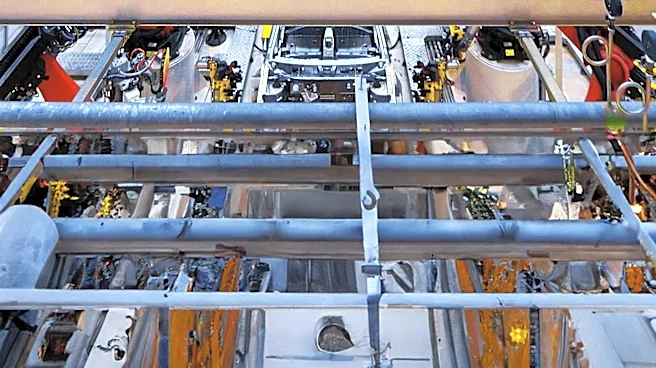
in 2010 and not yet recognizing any revenue as of the third quarter of 2026. The company inaugurated its highly automated Eagle Line pilot manufacturing facility in San Jose, California, in February. This facility is now actively producing increasing volumes of battery cells for customer testing. In October, QuantumScape announced plans to establish a 100-megawatt-hour production line, with operations slated to commence in 2028. This new line will specifically target applications in AI data centers, aerospace, and defense sectors. The company's QSE-5 prototype cells have demonstrated an energy density exceeding 844 watt-hours per liter and can charge from 10% to 80% in 12.2 minutes. However, the primary challenge remains the economic mass production of these advanced batteries, particularly the manufacturing of extremely thin ceramic separators with minimal defects.
Why It's Important?
The advancement of QuantumScape's solid-state battery technology holds significant implications for various U.S. industries, particularly electric vehicles, AI data centers, aerospace, and defense. Solid-state batteries offer the potential for lighter, more energy-dense power sources that charge considerably faster than conventional lithium-ion batteries. This could lead to longer-range electric vehicles, more efficient power solutions for data centers, and enhanced capabilities for aerospace and defense applications where performance and weight are critical. The successful commercialization of this technology could disrupt existing battery markets, creating new opportunities for companies that adopt it and posing a challenge to manufacturers of traditional lithium-ion batteries. While QuantumScape has secured an automotive partnership with Honda, its ongoing negotiations with Volkswagen's PowerCo highlight the complexities and high stakes involved in integrating new battery technologies into established supply chains. The ability to scale production economically will determine who ultimately gains or loses in this evolving energy storage landscape.
What's Next?
QuantumScape's immediate next steps involve increasing production volumes at its Eagle Line facility and continuing customer testing of its battery cells. The company is also focused on the development and eventual launch of its 100-megawatt-hour production line by 2028, which aims to serve the AI data center, aerospace, and defense markets. These sectors may offer a more viable path to initial commercialization outside the automotive industry, as customers in these areas might be more willing to pay a premium for superior battery performance. Furthermore, the outcome of negotiations with Volkswagen's PowerCo will be crucial, as milestone payments have been suspended during this period. The company will need to demonstrate its ability to manufacture its ceramic separators at scale without compromising quality or yield, while also contending with continuous improvements and cost reductions in conventional lithium-ion battery technology. Future developments will likely include further partnerships and strategic investments as QuantumScape seeks to solidify its market position.
Beyond the Headlines
The journey of QuantumScape underscores the profound challenges and immense capital requirements involved in bringing disruptive deep technology to market. Despite significant technological breakthroughs in the lab, the transition to mass production presents a formidable hurdle, requiring entirely new manufacturing processes and specialized equipment. This situation highlights a broader trend in advanced materials and energy storage, where scientific innovation often outpaces manufacturing capabilities and economic viability. The company's strategic pivot towards AI data centers, aerospace, and defense applications before widespread automotive adoption suggests a recognition that certain high-value, niche markets may be more receptive to premium-priced, high-performance solutions initially. This approach could establish a revenue stream and refine manufacturing processes before tackling the more cost-sensitive and high-volume automotive sector. The ongoing competition with improving conventional lithium-ion batteries also illustrates the dynamic nature of technological progress, where the 'moving target' of cost and performance demands continuous innovation and efficiency from new entrants.