







What's Happening?
The smart home industry is undergoing a significant shift from cloud-dependent artificial intelligence (AI) to on-device, local processing for appliances. This transition is driven by advancements in chip economics, making it feasible to embed powerful
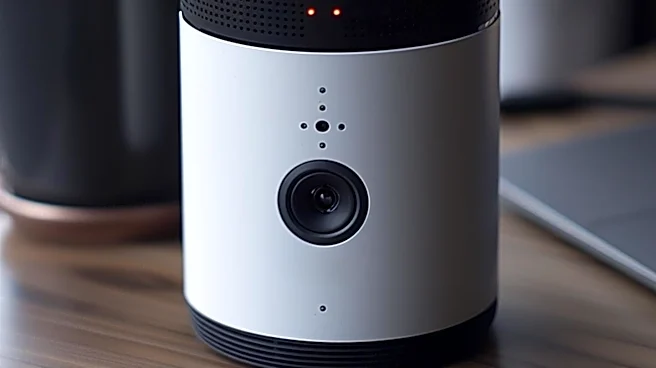
AI capabilities directly into consumer devices. Historically, smart home devices like the first-generation Amazon Echo relied heavily on cloud connectivity for AI functions such as voice recognition, leading to issues with reliability, latency, and privacy. However, modern low-cost application processors, such as Qualcomm’s QCM6490, MediaTek’s Genio series, and NXP’s i.MX 93, now offer the necessary inference capabilities to run complex AI models locally. A notable example is Samsung’s Bespoke AI Oven, launched in South Korea in 2023 and expanding globally, which features an internal camera and an on-device vision model to monitor food and adjust cooking settings without requiring cloud connectivity for its core AI function. This local processing capability improves privacy by keeping data on the device, reduces latency for quicker responses, and enhances device longevity by making them less reliant on continuous cloud service support.
Why It's Important?
This shift to local AI processing in appliances has profound implications for the U.S. smart home market and consumer technology. For consumers, it means more reliable, responsive, and private smart home experiences. The reduction in latency from hundreds of milliseconds to under 100 milliseconds for simple commands makes interactions feel instantaneous, significantly improving user satisfaction. Enhanced privacy is a critical benefit, as on-device processing means sensitive data, such as audio or visual information, does not leave the device without explicit user consent, addressing growing concerns about data security. Furthermore, device longevity is improved, as appliances will continue to function even if a service provider discontinues cloud support, protecting consumer investments. For U.S. businesses, this trend creates new opportunities for chip manufacturers, appliance makers, and software developers specializing in edge AI. Companies that can reliably build and update these local AI models over a device's lifetime will gain a competitive edge. It also challenges the traditional cloud-centric business models, pushing for innovation in on-device AI solutions and potentially fostering a more robust and resilient smart home ecosystem.
What's Next?
The future of AI in appliances will likely see the widespread adoption of vision-language models that combine visual understanding with natural language processing, enabling more sophisticated and conversational interactions. High-end devices are already beginning to incorporate these models, allowing for features like an 'always-available cooking assistant' that can analyze refrigerator contents and suggest recipes locally. The hardware required for these advancements, such as 5-7 TOPS processors and 4GB of RAM, is becoming increasingly affordable for mid-range kitchen appliances. The critical challenge for appliance manufacturers will be to reliably build these systems, ensure long-term model updates, and avoid the service-dependency pitfalls that plagued earlier cloud-dependent smart home devices. The decision for manufacturers is now more economic and architectural than purely technical, focusing on how to best integrate and support these local AI capabilities. This will drive further research and development in edge computing and AI optimization for consumer electronics, potentially leading to a new generation of truly intelligent and independent smart home devices.
Beyond the Headlines
The transition to local AI processing in smart home appliances represents a fundamental re-evaluation of the smart home paradigm, moving away from a centralized, cloud-dependent model towards a more distributed, device-centric approach. This shift has significant ethical and philosophical implications regarding autonomy and control. By empowering devices with on-board intelligence, users gain greater control over their data and the functionality of their appliances, reducing reliance on external service providers. This could foster a more resilient and user-centric technological landscape, where devices are less susceptible to external outages or changes in company policies. However, it also places a greater responsibility on manufacturers to ensure the security and ethical development of these on-device AI systems. The long-term impact could be a more robust and trustworthy smart home ecosystem, but it also necessitates careful consideration of how these powerful local AI capabilities are designed, maintained, and updated throughout the product lifecycle to prevent new forms of technological obsolescence or security vulnerabilities.