
What's Happening?
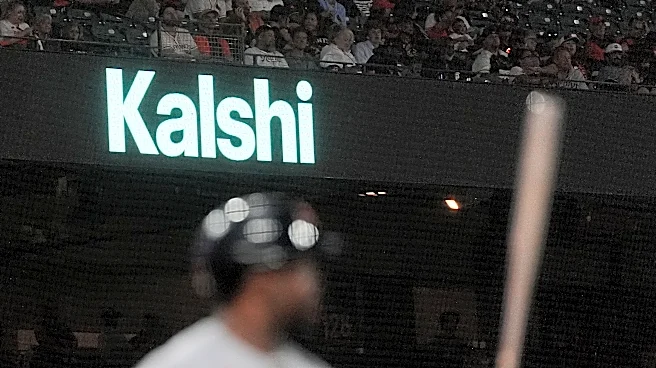
Utah has requested a court to dismiss the criminal charges it filed against prediction market operator Kalshi and its co-founders, CEO Tarek Mansour and COO Luana Lopes Lara. This decision comes after
Kalshi announced it had halted trading operations within Utah. The state's Attorney General, Derek Brown, cited a 'change in circumstance' in the motion filed in a Salt Lake City-based court. The felony charges, which included 13 counts of violating Utah's prohibition on gambling and one charge of profiting from illegal activity, were initially filed last month. Brown's office stated that the case could be refiled if Kalshi resumes offering trades in the state. Kalshi, the largest prediction market operator in the U.S., had previously halted trading in Utah after a federal judge did not immediately stop Utah's efforts to shut down its operations there. The company maintains that its 'event contracts' should be regulated as swaps under federal law, a view opposed by Utah and many other states.
Why It's Important?
This development highlights the ongoing regulatory conflict between states and the federal government regarding prediction markets. Utah's initial felony charges represented an aggressive tactic by a state to assert its authority over these platforms, which many states consider illegal gambling. The decision to drop charges, contingent on Kalshi's withdrawal from the state, sets a precedent for how states might enforce their gambling laws against similar platforms. The broader legal landscape remains fragmented, with litigation across more than 20 states, suggesting that the U.S. Supreme Court may ultimately need to resolve the issue of regulatory oversight. For Kalshi, the halt in trading in Utah, and previously in Nevada and partially in Michigan and Washington, underscores the significant operational challenges posed by this patchwork of state regulations. The outcome will influence the future of prediction markets and their accessibility to users nationwide.
What's Next?
While Utah has moved to drop the current charges, the underlying legal battle between Kalshi and the state is not entirely resolved. Kalshi had previously sued Utah in February, seeking to prevent the state from enforcing its gambling restrictions, and an appeal of a federal judge's rejection of that request is still pending. The company has indicated it will continue to fight in court for the right to operate in Utah, suggesting further legal proceedings are likely. The broader issue of federal versus state regulation of prediction markets is expected to continue, with analysts predicting a potential resolution by the U.S. Supreme Court given the widespread litigation across multiple states. The actions of other states, which largely share Utah's view that prediction markets constitute gambling, will also be closely watched as they consider their own regulatory approaches.
Beyond the Headlines
The conflict over prediction markets raises fundamental questions about the definition of gambling in the digital age and the scope of federal versus state regulatory power. Kalshi argues its 'event contracts' are financial instruments, akin to swaps, falling under federal commodity trading regulations. States like Utah, however, view them as a form of illegal gambling. This divergence highlights the challenge of applying existing legal frameworks to novel financial technologies. The outcome of these legal battles could have significant implications for innovation in financial markets, potentially stifling new platforms if they face a complex and contradictory regulatory environment across states. It also touches upon consumer access, as Kalshi noted the 'unfortunate outcome' for the 177,000 Utahns who used its platform, underscoring the tension between state-level consumer protection and broader market access.