




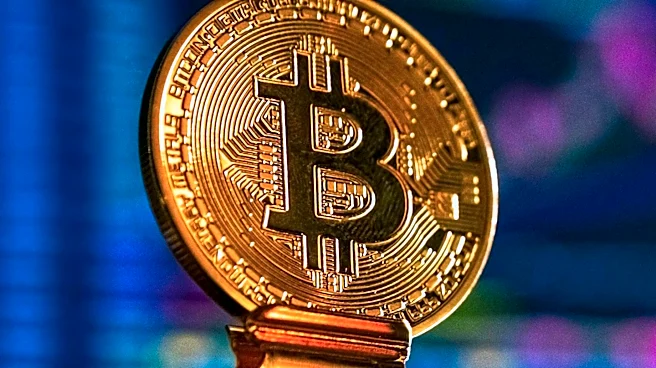

What's Happening?
JPMorgan Chase's Asset Management division predicts that Bitcoin's price will remain below $150,000 by the end of 2030, according to its base case scenario. This forecast suggests a compound annual growth rate (CAGR) of 10% over the next decade. While
this growth rate is considered modest compared to Bitcoin's historical boom-and-bust cycles, JPMorgan Chase anticipates Bitcoin will be the top-performing asset class over the next ten years, outperforming stocks, bonds, and gold. However, this performance is expected to come with significant volatility, rather than steady annual returns. The prediction is based on the view that Bitcoin is increasingly behaving like a traditional financial asset as it becomes more mainstream, leading to a tempering of expectations for triple-digit annual growth.
Why It's Important?
This prediction from a major financial institution like JPMorgan Chase carries significant weight for U.S. investors and the broader financial market. It signals a potential shift in how institutional players view Bitcoin, moving it from a purely speculative asset to one that, while still volatile, is being integrated into traditional financial analysis. For investors, this could mean a recalibration of expectations, moving away from 'get-rich-quick' narratives towards a more measured, long-term investment perspective. The emphasis on Bitcoin as a top-performing asset class, despite its volatility, could attract more institutional capital seeking higher returns than traditional investments, but also highlights the inherent risks. This perspective could influence asset allocation strategies and risk assessments for both individual and institutional portfolios in the U.S.
What's Next?
If Bitcoin follows JPMorgan Chase's base case scenario, its price could reach approximately $110,000 in four years, assuming it ends the current year around $75,000. A more bullish scenario, with a 17% CAGR, could see higher gains. The market will likely continue to experience significant price swings, reflecting Bitcoin's cyclical nature, where new all-time highs are often reached every four-year cycle. Investors will need to prepare for continued volatility, even as the asset matures. The increasing mainstream acceptance of Bitcoin may lead to further integration into financial products and services, potentially attracting a broader range of investors but also subjecting it to more traditional market forces and regulatory considerations.
Beyond the Headlines
The evolving perception of Bitcoin from a fringe digital currency to a recognized, albeit volatile, asset class by institutions like JPMorgan Chase reflects a broader trend of digital asset maturation. This shift has profound implications for financial regulation, market infrastructure, and investment education in the U.S. As Bitcoin becomes more 'traditional,' it may face increased scrutiny from regulators, potentially leading to more stringent compliance requirements for exchanges and investment vehicles. This could also spur the development of more sophisticated financial instruments and risk management tools tailored for digital assets. The long-term impact could be a more integrated, yet still distinct, digital asset ecosystem within the global financial landscape, challenging existing paradigms of value and investment.