






What's Happening?
Astranis Space Technologies, a company specializing in the design, construction, and operation of advanced satellites for high orbits, has successfully raised over $1.2 billion in funding. This significant investment comes from a consortium of prominent
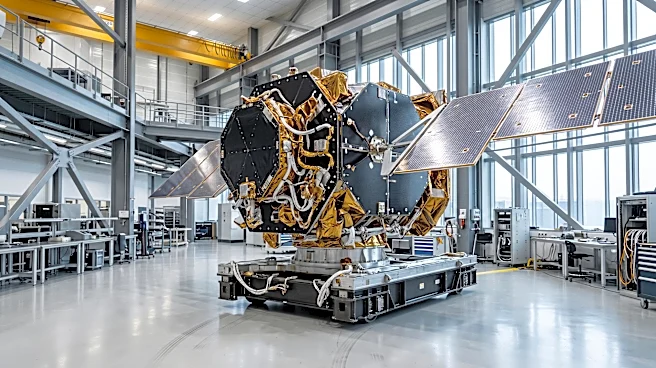
investors, including Andreessen Horowitz, Baillie Gifford, Blackrock, Fidelity, Franklin Templeton, and Snowpoint. The company, headquartered in Northern California, USA, employs a team of 500 engineers and entrepreneurs. Astranis currently has five satellites in orbit, with plans for numerous additional launches in the near future. These satellites are designed to provide dedicated and secure networks to a diverse clientele, including large enterprises, sovereign governments, and the U.S. military. The company boasts a commercial contract backlog exceeding $1 billion, positioning itself as a preferred partner for clients with stringent requirements for uptime, data security, network visibility, and customization in satellite communications. Astranis operates from a 153,000 sq. ft. facility where it designs, builds, and operates its satellite fleet.
Why It's Important?
This substantial funding round underscores growing investor confidence in the private space sector and the demand for advanced satellite communication services. For the U.S. economy, Astranis's operations contribute to job creation in high-tech engineering and manufacturing sectors, particularly in Northern California. The company's focus on providing secure and dedicated networks to government and military entities highlights its role in bolstering national security infrastructure and communication capabilities. Furthermore, by serving large enterprises, Astranis facilitates enhanced connectivity and data security, which are critical for various industries operating in an increasingly digital world. The over $1 billion backlog in commercial contracts indicates a robust market need for reliable satellite communications, suggesting potential for further growth and innovation within the U.S. space industry. This investment also signifies a broader trend of private companies taking on significant roles in space exploration and commercialization, traditionally dominated by government agencies.
What's Next?
With over $1.2 billion in new funding, Astranis is poised to accelerate its satellite deployment schedule and expand its operational capabilities. The company's immediate next steps will likely involve scaling up its manufacturing and launch operations to fulfill its existing backlog of over $1 billion in commercial contracts. This expansion will necessitate continued hiring of engineers and technical staff, further contributing to the U.S. tech workforce. Astranis will also focus on securing additional orbital slots and regulatory approvals, which are crucial for its ongoing growth and international operations. The company's continued development of advanced satellite technology could lead to new service offerings and increased competition in the satellite communications market, potentially benefiting end-users with more diverse and robust connectivity options. Future developments may also include strategic partnerships with other aerospace companies or telecommunications providers to broaden its market reach.
Beyond the Headlines
The success of companies like Astranis reflects a significant shift in the space industry, moving from government-led initiatives to a more commercialized and privately funded model. This trend has profound implications for technological innovation, as private companies often operate with greater agility and a focus on market demands. Ethically, the provision of secure networks to sovereign governments and the U.S. military raises questions about the dual-use nature of advanced satellite technology and the responsibilities of private entities in national security contexts. Legally, the expansion of satellite constellations necessitates robust regulatory frameworks, both domestically and internationally, to manage orbital debris, spectrum allocation, and potential interference. Culturally, the increasing accessibility of space through private ventures could inspire a new generation of scientists and engineers, fostering a renewed interest in space exploration and its potential benefits for humanity, such as bridging the digital divide for underserved populations globally.