


What's Happening?
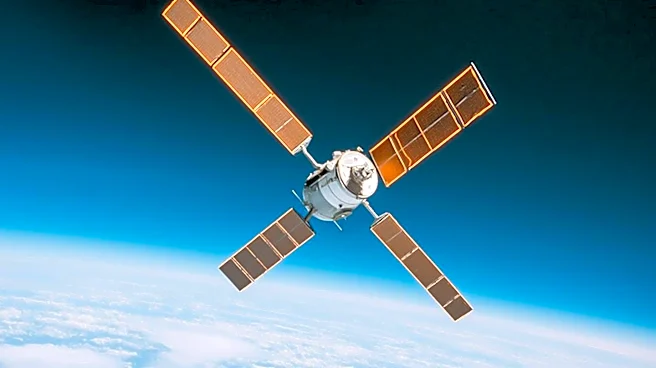
Researchers, led by the University of Surrey, have identified a method to reduce the cost of photovoltaic systems for space applications by up to 90%. Their study, "The Return of Silicon Solar Cells to Space," published in Acta Astronautica, suggests
that advancements in terrestrial silicon solar cell technology could make them a viable and cost-effective alternative to the currently dominant triple-junction solar cells. While silicon cells were used in early space missions, they were largely replaced by gallium arsenide (GaAs)-based technologies due to higher efficiency and radiation resistance. However, modern silicon technologies like heterojunction (HJT), TOPCon, PERC, and perovskite/silicon tandem cells now offer high efficiencies at significantly lower manufacturing costs. For instance, industry prices for triple-junction cells range from $250-$450/W, whereas modern silicon technologies can be less than $1/W, with HJT estimated at $0.39/W.
Why It's Important?
This research has significant implications for the space industry, particularly for the U.S. as it seeks to expand its presence in space through initiatives like satellite constellations and lunar missions. Reducing the cost of satellite solar power by such a substantial margin could democratize access to space, enabling more frequent and less expensive satellite launches for various applications, including communication, Earth observation, and scientific research. The lower cost could also accelerate the development of larger and more complex space infrastructure. While modern silicon cells have a lower beginning-of-life (BOL) power output density and are less radiation-resistant than triple-junction cells, their cost advantage is so substantial that even with increased panel size to match power output, they remain significantly cheaper. This cost reduction could free up budget for other critical components or payloads, fostering innovation and growth in the U.S. aerospace sector.
What's Next?
The next steps involve further qualification of terrestrial silicon cells for the harsh space environment. While the cost benefits are clear, researchers caution that these cells cannot be directly transferred to space without addressing challenges such as charged-particle radiation, extreme thermal cycling, ultraviolet radiation, vacuum, and atomic oxygen, all of which can impact performance and durability. Future development will focus on improving radiation resistance and reducing the amount of coverglass required, as coverglass is a major cost component for silicon cells in space. The study also highlights the need to consider end-of-life performance and mission duration, as triple-junction cells are expected to have higher performance after five years. Continued research and development in these areas will be crucial for silicon solar cells to become a widespread and reliable solution for future space photovoltaic applications, potentially leading to new manufacturing processes and supply chains within the U.S. to support this emerging market.
Beyond the Headlines
The potential re-adoption of silicon solar cells for space applications represents a fascinating full-circle moment in technological evolution, driven by continuous innovation in materials science and manufacturing. Beyond the immediate cost savings, this shift could foster greater resilience in space technology supply chains, as silicon PV benefits from the vast manufacturing capacity and established infrastructure of the terrestrial solar industry. This contrasts with the more specialized and limited supply chains for triple-junction cells. The ethical implications of cheaper space access include the potential for increased space debris and the need for more robust international regulations for satellite deployment and end-of-life management. Culturally, a more accessible space could inspire a new generation of scientists and engineers, further solidifying the U.S.'s leadership in space exploration and commercialization. This development underscores how advancements in one sector (terrestrial solar) can unexpectedly revolutionize another (space technology), creating unforeseen opportunities and challenges.