





What's Happening?
The Automate 2026 event showcased significant advancements in the robotics industry, emphasizing a shift from early-stage humanoid robots to practical applications of physical AI and edge computing. The event featured discussions on how software orchestration,
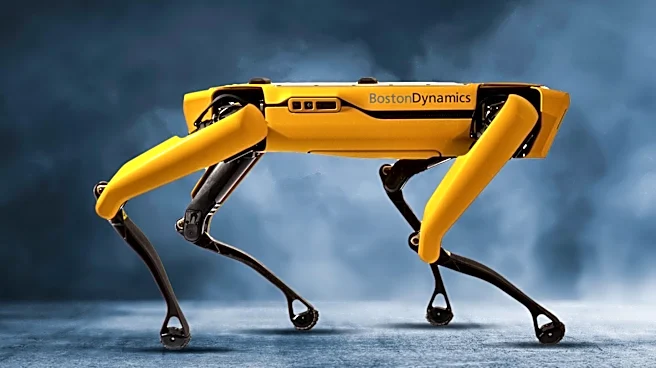
digital twins, and advanced kinematics are addressing labor shortages and preserving manufacturing knowledge. Notable companies such as Boston Dynamics, ABB Robotics, and FANUC presented their innovations. ABB Robotics highlighted AI-powered palletizing and collaborations with NVIDIA, while FANUC demonstrated real-time motion tracking and natural language robot programming. Schneider Electric and Siemens discussed their approaches to overcoming cloud latency and utilizing hybrid edge/cloud systems. Rockwell Automation introduced FactoryTalk Orchestration, and Kassow Robots showcased the advantages of 7-axis cobots.
Why It's Important?
The developments at Automate 2026 reflect a broader trend in the robotics industry towards integrating AI and automation to solve real-world challenges. This shift is crucial for industries facing labor shortages and the need for efficient manufacturing processes. By adopting advanced robotics and AI solutions, companies can enhance productivity, reduce operational costs, and maintain competitiveness in a rapidly evolving market. The focus on practical applications rather than speculative technologies indicates a maturation of the robotics sector, which could lead to increased adoption across various industries, including manufacturing, logistics, and healthcare.
What's Next?
As the robotics industry continues to evolve, companies are likely to focus on refining AI and automation technologies to further enhance efficiency and adaptability. Future developments may include more sophisticated AI algorithms, improved human-robot collaboration, and expanded use of digital twins for predictive maintenance and optimization. Stakeholders, including manufacturers and technology providers, will need to collaborate to address challenges such as data security, interoperability, and workforce training. The ongoing advancements in robotics could also prompt regulatory bodies to update standards and guidelines to ensure safe and ethical deployment of these technologies.