




What's Happening?
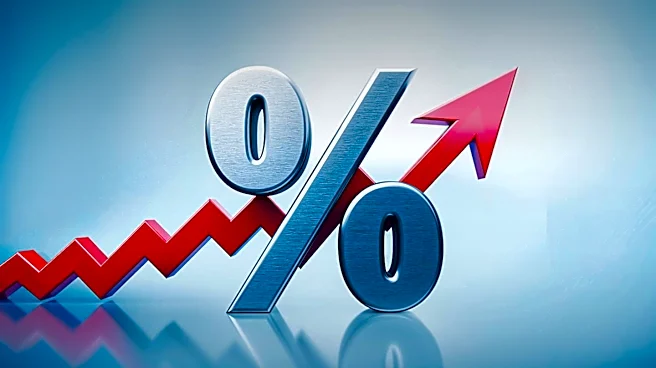
J.P. Morgan Global Research has significantly altered its forecast for Federal Reserve interest-rate hikes, moving away from its previous 'one and done' prediction. The Wall Street brokerage now anticipates three additional 25-basis-point rate increases:
one in December, followed by two more at the Federal Open Market Committee's January and March meetings. This revised outlook aligns with signals from other Fed watchers and officials who believe inflation remains too high, necessitating further monetary tightening. J.P. Morgan strategists, led by Michael Feroli, indicate these hikes are crucial for preserving the Fed's credibility, especially in the absence of a clear narrative for pausing rate increases. The firm also notes that while the labor market has not been a primary driver of inflationary pressure, inflation persists, and modest job growth is still expected next year.
Why It's Important?
This shift in J.P. Morgan's forecast carries substantial implications for U.S. consumers, businesses, and investors. For consumers, it means higher interest rates on various financial products, including credit cards, student loans, and home-equity loans, extending into early 2027. Indirectly, mortgage rates and Treasury bond yields will also be affected, potentially increasing borrowing costs for housing and government debt. Businesses will face higher borrowing costs, which could impact investment decisions and operational expenses. For investors, higher interest rates ripple through the stock market by influencing discounted cash flows, corporate borrowing costs, and asset allocation strategies. The absence of a clear 'overarching narrative' from the Fed, as noted by J.P. Morgan, suggests that future monetary policy will be highly reactive to incoming economic data, creating a less predictable environment for financial markets.
What's Next?
Following J.P. Morgan's revised forecast, the financial markets will closely monitor the Federal Reserve's upcoming meetings in December, January, and March for confirmation of these anticipated rate hikes. Brokerages like BofA Global Research and Deutsche Bank also expect similar increases, suggesting a consensus among major financial institutions regarding the Fed's likely path. Consumers and businesses should prepare for a sustained period of higher borrowing costs. The Fed's communication, particularly regarding its 'forward guidance,' will be critical in shaping market expectations and economic behavior. Without a clear long-term strategy, the Fed's decisions will be heavily influenced by real-time economic data, potentially leading to more volatile market reactions to economic reports.
Beyond the Headlines
The revised forecast highlights a deeper challenge for the Federal Reserve: managing inflation while maintaining economic stability without a clear 'pole star' or overarching narrative for its policy. The reliance on reactive data-driven decisions, as suggested by J.P. Morgan, could lead to increased uncertainty and potentially more abrupt policy shifts. This situation underscores the delicate balance the Fed must strike between taming inflation and avoiding an overly restrictive monetary policy that could trigger a significant economic downturn. The long-term implications could include a re-evaluation of how the Fed communicates its intentions to the public and financial markets, potentially leading to new approaches to forward guidance to restore predictability and confidence.