



What's Happening?
Several digital infrastructure companies, traditionally focused on Bitcoin mining, are increasingly pivoting their operations towards artificial intelligence (AI) data centers. This shift is driven by growing demand from hyperscalers and GPU customers
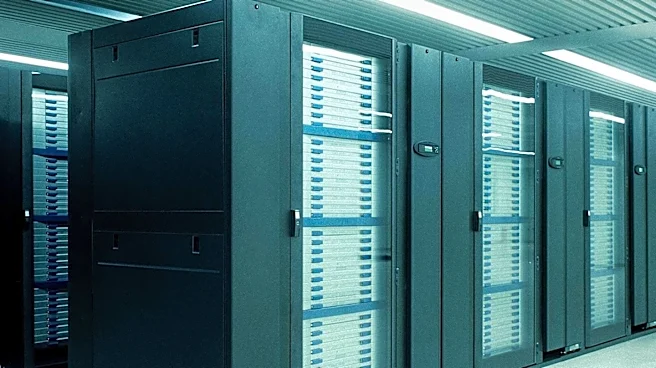
for AI-specific infrastructure. Companies like Applied Digital, IREN Limited, and Core Scientific have seen their stock prices climb, with Applied Digital and IREN each up 6%, and Core Scientific gaining 4%. Core Scientific, for instance, is converting its mining facilities into high-density colocation centers for AI and compute-intensive workloads, securing anchor deals with CoreWeave and AMD totaling 1.1 GW and $24 billion in potential contracted revenue. Similarly, IREN Limited is leveraging its NVIDIA AI Cloud partnership, and Cipher Mining is repurposing its Black Pearl campus for High-Performance Computing (HPC) colocation.
Why It's Important?
This strategic pivot signifies a significant evolution within the digital infrastructure sector, moving beyond the volatile economics of Bitcoin mining towards the more stable and rapidly expanding AI market. The shift provides these companies with long-term, contracted revenue streams, offering greater financial predictability compared to the fluctuating rewards of cryptocurrency mining. For instance, Core Scientific's 12-year and 15-year agreements with CoreWeave and AMD, respectively, demonstrate a commitment to sustained revenue. This trend also highlights the increasing demand for specialized computing power and infrastructure required to support advanced AI applications, positioning these companies as critical enablers of the AI boom. The move allows them to capitalize on their existing expertise in managing large data centers and securing cheap electricity, which are essential for both Bitcoin mining and AI operations.
What's Next?
The trend of Bitcoin miners transitioning to AI data centers is expected to continue, with more companies likely to follow suit to secure long-term revenue and stability. Companies will focus on retrofitting their existing infrastructure or building new facilities optimized for AI and HPC workloads. This will involve significant investment in specialized hardware, such as GPUs, and advanced cooling systems. The market will likely see further partnerships and contracts between these digital infrastructure providers and major AI developers or hyperscalers. Investors will be closely watching for additional hyperscaler contract announcements, which have been key drivers for stock rerating in this group. The long-term implications include a more diversified and resilient digital infrastructure industry, less dependent on the price fluctuations of cryptocurrencies.
Beyond the Headlines
This pivot underscores a broader economic and technological realignment, where the foundational infrastructure developed for one cutting-edge technology (blockchain/cryptocurrency) is being repurposed to serve another (AI). It highlights the fungibility of high-performance computing resources and the strategic advantage held by companies with existing large-scale data center operations and access to affordable power. The shift also raises questions about the future of Bitcoin mining, as major players divert resources, potentially impacting the network's hash rate and decentralization in the long run. Furthermore, the increasing demand for AI infrastructure could intensify competition for energy resources and land, potentially leading to new environmental and regulatory considerations for these data-intensive operations.