






What's Happening?
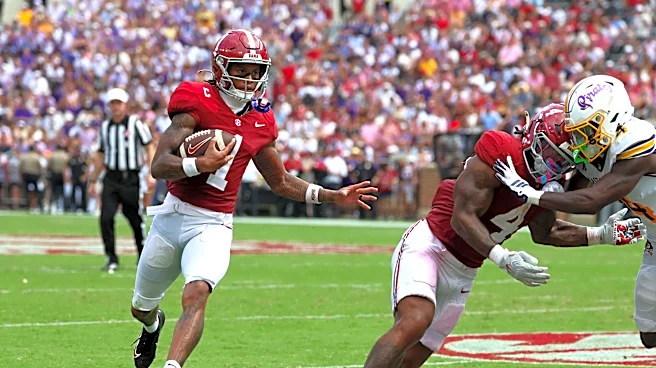
Alabama football wide receiver Ryan Coleman-Williams has decided to continue playing without gloves for the upcoming game against Kentucky. This decision follows his earlier commitment not to wear gloves this season, a choice he made after experiencing
issues with dropped passes during his sophomore year. Despite dropping the football twice in the recent game against East Carolina, Coleman-Williams still delivered an impressive performance, securing five receptions for 130 receiving yards. His consistent adherence to this personal choice indicates a strategic approach to improving his game and maintaining focus on his receiving technique. The game against Kentucky is scheduled for a 2:30 p.m. CT kickoff and will be broadcast on ABC.
Why It's Important?
Ryan Coleman-Williams' decision to play without gloves is significant for several reasons within the context of college football. For an athlete, such a choice often reflects a deep understanding of their own mechanics and a commitment to overcoming past performance issues through unconventional means. Dropped passes can be a major impediment to a wide receiver's effectiveness and confidence, and by foregoing gloves, Coleman-Williams is likely aiming to enhance his natural feel for the ball, potentially improving his grip and concentration. This personal strategy could serve as an example for other athletes facing similar challenges, highlighting the importance of self-assessment and tailored solutions. For the Alabama team, his continued strong performance, despite the initial drops, demonstrates resilience and adaptability, which are crucial attributes for success in high-stakes collegiate sports. His performance will be closely watched as it could influence future equipment choices for other players.
What's Next?
As Ryan Coleman-Williams continues to play without gloves, his performance in upcoming games, particularly against Kentucky, will be closely scrutinized. His ability to maintain or improve his receiving statistics without the aid of gloves will be a key indicator of the effectiveness of his decision. Should he continue to perform at a high level, it could reinforce his personal strategy and potentially influence other wide receivers to experiment with their equipment choices. Conversely, if dropped passes become a recurring issue, he might reconsider his approach. The coaching staff will likely monitor his progress closely, providing support and adjustments as needed. His journey will be a compelling narrative within the Alabama football season, showcasing an athlete's dedication to personal improvement and strategic adaptation.
Beyond the Headlines
Ryan Coleman-Williams' decision to play without gloves transcends a simple equipment choice; it delves into the psychological and physiological aspects of athletic performance. For many athletes, equipment provides a sense of security or an perceived advantage. By removing gloves, Coleman-Williams is potentially engaging in a mental challenge, forcing himself to rely solely on his natural hand-eye coordination and focus. This could build mental toughness and resilience, qualities that are invaluable in competitive sports. Physiologically, playing without gloves might enhance tactile feedback, allowing for a more direct and nuanced feel of the football, which could improve ball security over time. This unconventional approach highlights the individualized nature of athletic optimization and the continuous search for marginal gains that can differentiate top performers in highly competitive environments like college football.