








What's Happening?
James Fisher and Sons, in collaboration with Aquaterra Energy, has announced a strategic global partnership aimed at providing integrated offshore decommissioning services. This partnership will combine front-end engineering, well access, subsea operations,
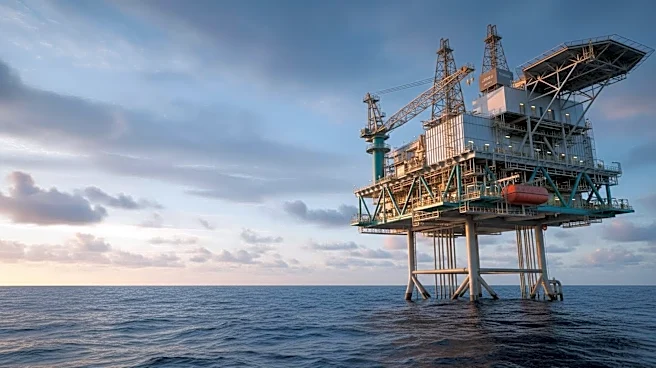
and offshore execution into a single delivery model. The initiative is designed to streamline the process of well abandonment and offshore infrastructure removal by reducing contractor interfaces and enhancing coordination from project planning through execution. Initially, the partnership will focus on regions such as the North Sea, Asia-Pacific, and the Middle East, where a significant number of offshore wells and installations are nearing the end of their operational life. The UK Continental Shelf alone has 153 wells that have surpassed their decommissioning consent deadlines, and the North Sea Transition Authority estimates that approximately $59 billion remains to be spent on decommissioning activities. Globally, over 2,500 offshore structures are expected to require decommissioning by 2040.
Why It's Important?
The partnership between James Fisher and Aquaterra Energy is significant as it addresses the growing need for efficient and cost-effective decommissioning solutions in the offshore energy sector. With a substantial number of offshore structures nearing the end of their operational life, the demand for decommissioning services is expected to rise sharply. This collaboration aims to provide operators with greater execution certainty and flexibility, which is crucial as decommissioning projects become more technically demanding and commercially pressured. By offering a scalable and field-proven approach, the partnership seeks to enhance safety and efficiency in decommissioning activities, potentially reducing costs and project durations. This development is particularly relevant for regions like the North Sea and Asia-Pacific, where decommissioning liabilities are projected to reach significant levels in the coming decades.
What's Next?
The partnership will initially target the North Sea, Asia-Pacific, and the Middle East, focusing on regions with a high concentration of aging offshore infrastructure. As the collaboration progresses, it is expected to expand its services to other global markets facing similar decommissioning challenges. The integrated approach is designed to adapt to evolving project requirements, providing operators with the confidence to undertake complex decommissioning programs. The success of this partnership could set a precedent for future collaborations in the industry, encouraging more integrated and efficient decommissioning solutions worldwide.