







What's Happening?
Qianhai, a cooperation zone in Shenzhen, China, is positioning itself as a central hub for Asia-Pacific cooperation, leveraging the upcoming 33rd APEC Economic Leaders' Meeting in Shenzhen in November 2026. The region is actively deepening economic and
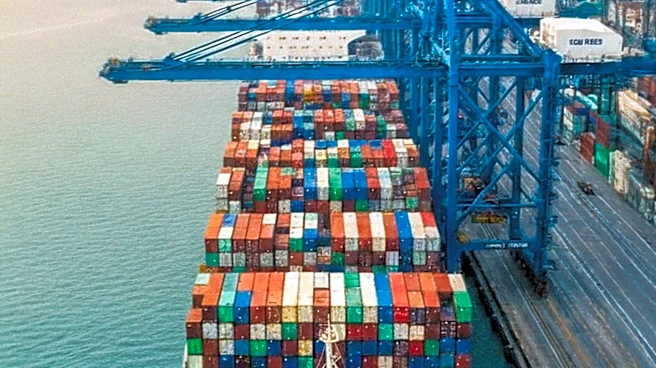
trade ties with Asia-Pacific economies, with supply chains being a critical focus. As of September 2026, Qianhai hosts the headquarters of 20 5A-level logistics enterprises, representing 47.6% of Shenzhen's total. The 'Qianhai + Hong Kong' model is facilitating market expansion for businesses by combining Qianhai's institutional innovation and industrial hinterland with Hong Kong's global network and legal services. This partnership has led to initiatives like the mutual recognition of technical standards for home appliances between mainland China and Hong Kong, significantly reducing time-to-market and costs for companies like Shenzhen Shuye Innovation Technology Co., Ltd. Additionally, the Shenzhen · Qianhai International Business e-Station is providing one-stop digital foreign trade services, partnering with Alibaba.com Hong Kong and establishing partnerships with 53 overseas industrial parks.
Why It's Important?
Qianhai's strategic development as an APEC hub has significant implications for U.S. businesses and trade relations within the Asia-Pacific region. The 'Qianhai + Hong Kong' model, by streamlining logistics and standardizing technical requirements, can reduce trade barriers and operational complexities for U.S. companies looking to access the Chinese and broader Asia-Pacific markets. The presence of numerous logistics enterprises and the digital foreign trade services offered by the e-Station can enhance supply chain efficiency, potentially lowering costs and improving market access for U.S. exports and imports. This increased integration and standardization within the Asia-Pacific could also influence U.S. trade policy and investment strategies, as American businesses seek to capitalize on or adapt to these evolving regional dynamics. The focus on economic and trade exchanges, regulatory alignment, and Shenzhen-Hong Kong synergy underscores a concerted effort to create a more interconnected and efficient trading environment.
What's Next?
The upcoming APEC meeting in Shenzhen is expected to further solidify Qianhai's role as a regional cooperation platform, potentially leading to deeper standard exchanges and industrial cooperation across the Asia-Pacific. Companies like Shenzhen SPARO Technology are looking to utilize this meeting to expand their reach and showcase innovations. The continued development of international urban amenities in Qianhai, such as the Qianhai Museum and 'Qianhai Surge,' aims to attract global enterprises and talent, further enhancing its status as a business hub. U.S. businesses should monitor the outcomes of the APEC meeting and subsequent policy implementations in Qianhai, as these could present new opportunities for market entry, partnerships, and supply chain optimization within the Asia-Pacific region. The ongoing efforts to align regulations and foster economic integration will likely continue to shape the regional trade landscape.
Beyond the Headlines
The emergence of Qianhai as a central hub for Asia-Pacific cooperation highlights a broader trend of regional economic integration and the strategic importance of specific urban centers in driving global trade. This development could lead to a re-evaluation of traditional trade routes and investment patterns, with a greater emphasis on interconnected regional networks. The 'Qianhai + Hong Kong' model exemplifies a novel approach to cross-border collaboration, blending different legal and economic systems to create a more efficient business environment. This model could serve as a blueprint for other regions seeking to enhance economic synergy. Furthermore, the focus on digital foreign trade services and the integration of technology in logistics points towards a future where trade is increasingly digitized and automated, raising questions about data governance, cybersecurity, and the future of work in the logistics sector. The long-term implications include potential shifts in global economic power and the rise of new trade corridors.