






What's Happening?
Agentic AI is emerging as a transformative technology in robotics, enabling robots to self-learn and refine behaviors through interactions, moving beyond traditional reliance on vast datasets for every task. Researchers at the University of California
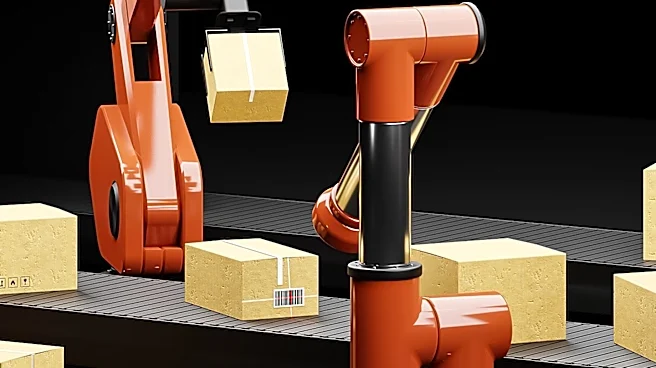
Berkeley and NVIDIA, led by Professor Ken Goldberg, have developed new AI models that allow teams of agents to generate, test, and refine robot programs in simulated environments. This approach, particularly through the Graph-as-Policy (GaP) framework, allows robots to adapt to variations in object geometry and pose, crucial for tasks like package sorting or food preparation. Unlike conventional methods that require extensive manual programming or large datasets of physical demonstrations, agentic AI can quickly iterate and improve robot performance. For instance, Ambi Robotics, a U.S.-based logistics company, has deployed this new agentic approach in 30% of its fleet, resulting in an increased capacity of over 15,000 packages sorted annually per robot. This demonstrates the practical application and significant potential of agentic AI in real-world industrial settings, moving beyond academic studies.
Why It's Important?
The advancement of agentic AI in robotics holds significant implications for U.S. industries, particularly in manufacturing, logistics, and service sectors. By enabling robots to learn and adapt more quickly, this technology can drastically reduce the time and resources required for robot programming and deployment. This translates to increased efficiency, higher throughput, and potentially lower operational costs for businesses. Companies like Ambi Robotics are already seeing tangible benefits, such as enhanced package sorting capacity, which can alleviate supply chain pressures and improve delivery speeds. The ability of agentic AI to handle 'variational automation' tasks—those with dynamic object interactions—opens up new possibilities for automation in areas previously deemed too complex or unpredictable for traditional robotics. This could lead to a more flexible and resilient industrial infrastructure, allowing U.S. businesses to better respond to changing market demands and labor availability. Furthermore, it could foster innovation in robot design and application, creating new job opportunities in AI development, robot maintenance, and system integration.
What's Next?
The continued development and deployment of agentic AI in robotics are expected to accelerate, with further integration into various industrial applications. Researchers will likely focus on enhancing the robustness and generalizability of agentic systems, allowing robots to perform an even wider array of complex tasks with minimal human intervention. The success seen in logistics with Ambi Robotics suggests that other sectors facing similar challenges, such as manufacturing assembly, warehousing, and even specialized service industries, will explore adopting these technologies. We can anticipate increased investment from technology companies and venture capitalists in startups developing agentic AI solutions for robotics. Furthermore, as these systems become more sophisticated, there will be a growing need for skilled professionals in AI engineering, robotics, and data science to manage, optimize, and maintain these advanced robotic fleets. The iterative learning capabilities of agentic AI also imply that robots will continuously improve their performance over time, leading to more autonomous and efficient operations across industries.
Beyond the Headlines
The rise of agentic AI in robotics extends beyond mere operational efficiency, touching upon deeper ethical and societal implications. As robots become more autonomous and capable of self-learning, questions about accountability, decision-making in unforeseen circumstances, and the nature of human-robot collaboration will become more prominent. The ability of agentic AI to 'diagnose failures' and 'edit the graph' of its own programming raises considerations about the level of human oversight required and the potential for unintended consequences in complex environments. This technological shift could also redefine the future of work, necessitating a re-evaluation of workforce training and education to prepare for a landscape where humans increasingly work alongside intelligent, adaptive machines. Furthermore, the development of frameworks like GaP, which allow for modular skill improvement, could lead to a democratization of robotics, making advanced automation more accessible to a broader range of businesses, including small and medium-sized enterprises, thereby leveling the playing field in various industries.