






What's Happening?
The artificial intelligence boom is creating a significant divergence within the semiconductor industry, with strong demand for AI data center chips contrasting sharply with a weakening PC market. AMD reported a near-doubling of its data center business
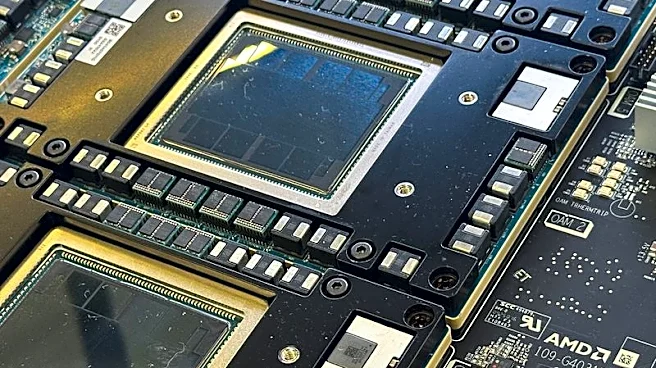
in the third quarter, driving its revenue to a record $13.4 billion. This growth was primarily fueled by its EPYC server processors and the launch of its Instinct MI450 Series GPUs, essential for training and running AI models, with the data center segment now accounting for almost two-thirds of AMD's revenue. In contrast, Intel warned of a weakening PC market, projecting fourth-quarter sales below Wall Street expectations. Intel's client computing group, its largest business, saw a 5% decline in the third quarter, and the company anticipates PC segment sales to fall over 20% from the previous quarter in Q4. This shift is partly attributed to AI's absorption of high-bandwidth memory, which is raising PC costs and impacting consumer demand.
Why It's Important?
This split in the chip industry has profound implications for the U.S. technology sector and broader economy. AMD's robust performance in AI chips positions it as a key player in the rapidly expanding AI infrastructure market, potentially leading to increased investment and job creation in high-tech manufacturing and R&D within the U.S. Conversely, Intel's struggles in the PC market highlight a challenge for a long-standing American tech giant, potentially impacting its market share and future investment strategies in traditional computing. The shift in memory production towards AI processors also signifies a reallocation of resources within the semiconductor supply chain, which could lead to higher costs and potential shortages for PC manufacturers and consumers. This dynamic underscores the transformative power of AI, reshaping market priorities and competitive landscapes for major U.S. chipmakers.
What's Next?
AMD anticipates continued strong growth, with its fourth-quarter outlook implying approximately 66% year-over-year growth as it scales production of its Helios rack-scale AI systems. Intel, however, expects PC market weakness to persist at least through the first half of 2027, with memory supply constraints being a significant factor. Both companies will likely continue to heavily invest in AI chip development and manufacturing to capitalize on the booming demand. Intel's foundry business, while growing, is still operating at a loss, and its ability to turn this into profit will be crucial for its long-term strategy in U.S. chipmaking. The industry will closely watch how these companies navigate the evolving market, particularly regarding their ability to secure memory supplies and adapt to the shifting demands of AI versus traditional computing.
Beyond the Headlines
The divergence between AI and PC chip markets reveals a deeper structural change in computing priorities. The immense computational demands of AI are not just driving innovation but also reallocating critical resources like high-bandwidth memory, creating a scarcity that impacts other sectors. This could accelerate the trend towards more specialized computing architectures, potentially leading to a future where general-purpose PCs become less central to technological advancement compared to AI-optimized data centers. Furthermore, the competitive dynamics between AMD and Intel in this new AI-driven era could influence national technology policy, particularly regarding domestic chip manufacturing and supply chain resilience. The long-term implications include potential shifts in consumer technology trends, with AI capabilities becoming a more dominant factor in hardware design and purchasing decisions, potentially at the expense of traditional PC performance metrics.