





What's Happening?
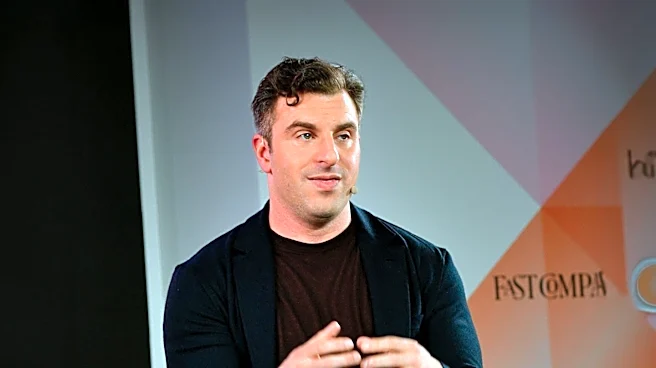
Brian Chesky, Airbnb's co-founder and CEO, asserts that artificial intelligence (AI) acts as an amplifier, significantly widening the performance gap between individuals rather than leveling the playing field. He believes that those who understand how
to leverage AI to build effectively and relentlessly practice their craft will emerge as leaders. Chesky's perspective stems from Airbnb's extensive AI-native redesign, which includes features like a natural-language search toggle, AI-generated listing highlights, and side-by-side comparison tools. The company is also expanding into bookable services such as chefs, masseuses, and ski rentals, aiming to transform its platform into a more comprehensive travel community. Chesky emphasizes that Airbnb is rebuilding its application as an 'agent' rather than a mere chatbot, viewing an agent as a more intelligent and understanding evolution of an application that leverages AI's power. This redesign aims to modernize every touchpoint of the app, making it more intelligent and user-friendly for both guests and hosts.
Why It's Important?
Chesky's insights highlight a critical shift in the professional landscape, suggesting that AI will not democratize skill but rather amplify existing talent, potentially leading to a more stratified workforce. This has significant implications for U.S. industries, as companies will need to focus on identifying and nurturing individuals who possess the vision and capability to effectively utilize AI tools. For the travel and hospitality sectors, Airbnb's AI-driven expansion into services could disrupt traditional models by providing small businesses and individual service providers with a global distribution platform they previously lacked. This could create new economic opportunities for local entrepreneurs while intensifying competition for established service providers. The emphasis on an 'agent' model over chatbots also signals a potential future direction for application development, where AI is deeply integrated to provide personalized and intelligent user experiences, influencing how other tech companies approach their product strategies.
What's Next?
Airbnb's AI-native redesign is already in the process of rolling out, with features like the AI search toggle and AI-generated highlights becoming available to users. The expansion into bookable services is currently in various testing phases, with plans to extend these offerings globally. The success of Airbnb's 'travel graph,' which aims to connect friends and family for travel recommendations, will depend on user adoption and willingness to integrate social connections with a booking platform. This initiative could establish a unique social layer for Airbnb, differentiating it from competitors. Furthermore, Chesky anticipates the emergence of many more large AI companies and millions of small ones, suggesting a continued boom in AI-driven innovation and entrepreneurship. This forecast implies that businesses and individuals across various sectors will need to continuously adapt to evolving AI capabilities and integrate them into their operations to remain competitive.
Beyond the Headlines
The broader implications of Chesky's views extend to the ethical and societal dimensions of AI's impact on labor and skill development. If AI indeed amplifies existing talent gaps, it could exacerbate income inequality and create a more pronounced divide between highly skilled AI-proficient workers and those who are not. This raises questions about the need for new educational paradigms and workforce retraining programs to ensure a broader segment of the population can benefit from AI advancements. Culturally, Airbnb's push to become a 'travel community' through its travel graph and emphasis on offline experiences could influence how people connect and plan trips, potentially fostering a return to more personalized and community-driven travel. The shift from simple marketplaces to intelligent 'agents' also signifies a long-term trend in user interface design, where applications become more proactive and intuitive, fundamentally changing user expectations for digital interactions.