





What's Happening?
Scientists may have finally uncovered a 137-year-old secret behind Vincent van Gogh’s iconic painting, 'The Starry Night.' Researchers from Kyung Hee University in South Korea conducted a study comparing the painting with astronomical simulations of the sky
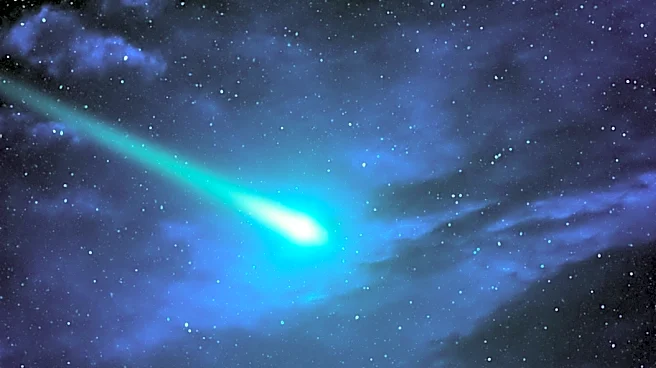
above the French Mental Asylum where Van Gogh resided in 1889. By cross-examining the lunar phase and dawn weather conditions between July 20 and 24, 1889, experts pinpointed July 22, 1889, as the likely date of a celestial event that could have inspired the artwork. The simulation revealed a strong match, showing Venus visible near the horizon, a thin, waning crescent moon, and the Hyades star cluster forming a V-shaped pattern in the top-left corner, closely aligning with the painting's celestial features.
Why It's Important?
This research offers a compelling, fact-based explanation for the astronomical elements depicted in 'The Starry Night,' moving beyond the long-held belief that the scene was entirely a product of Van Gogh's imagination. By linking the painting to a specific celestial event, the study provides a deeper understanding of the artist's observational skills and his engagement with the natural world, even during a period of personal turmoil. This finding enriches the art historical context of one of the most famous paintings in the world, demonstrating how scientific methods can illuminate artistic creation. It also highlights the enduring human fascination with the night sky and its influence on culture and art.
What's Next?
The findings are expected to spark further interdisciplinary research, encouraging art historians and astronomers to collaborate on analyzing other artworks that feature celestial elements. This methodology could be applied to other historical paintings to uncover potential astronomical inspirations, offering new perspectives on artistic interpretations of the cosmos. While Van Gogh likely did not depict the event with photographic accuracy, the strong correlation suggests a significant influence. Future studies might delve into how artists of different eras perceived and represented astronomical phenomena, contributing to both art history and the history of science.
Beyond the Headlines
The revelation that 'The Starry Night' might be rooted in a real celestial observation adds another layer of depth to Van Gogh's artistic genius. It suggests that even in his most expressive and emotionally charged works, there was an underlying connection to reality. This blend of objective observation and subjective interpretation is a hallmark of great art. The study also underscores the power of astronomical events to captivate and inspire, transcending time and cultural boundaries. It reminds us that the night sky has always been a source of wonder, influencing human creativity and thought in profound ways, from ancient myths to modern scientific inquiry.