






What's Happening?
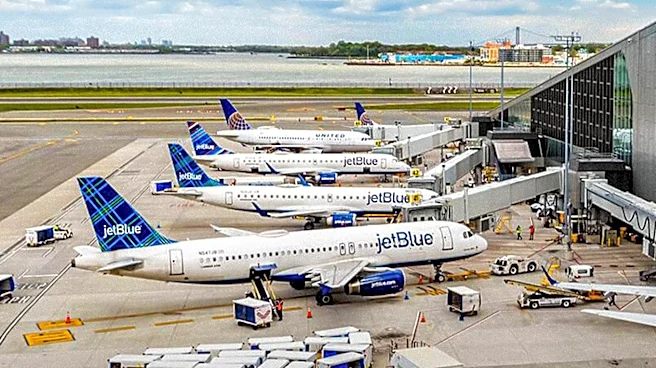
United Airlines Chief Financial Officer Mike Leskinen has downplayed recent speculation regarding a potential merger with JetBlue. Speaking at the Wings Club in New York, Leskinen addressed industry chatter that intensified following JetBlue's bond selloff
in October. He emphasized that any acquisition consideration must account for the target airline's entire enterprise value, not just its equity value. Leskinen specifically pointed to JetBlue's "very large debt balance" as a significant deterrent. He also stated that United's existing hubs in Washington Dulles and Houston already provide sufficient connectivity to regions like the Caribbean and Latin America, negating a primary perceived benefit of acquiring JetBlue.
Why It's Important?
This dismissal of merger talks by United's CFO is important for several reasons. Firstly, it provides clarity to the market regarding United's strategic direction, indicating that the airline is not currently pursuing an acquisition of JetBlue despite recent industry rumors. This can impact investor confidence and stock valuations for both airlines. Secondly, Leskinen's focus on JetBlue's substantial debt highlights a critical factor in airline mergers: the financial health and leverage of potential acquisition targets. This perspective offers insight into the rigorous financial due diligence involved in such large-scale transactions. Lastly, United's assertion that its current hub network adequately serves key international regions suggests a confidence in its organic growth strategy and existing operational footprint, potentially influencing future route development and competitive dynamics in the airline industry.
What's Next?
With United Airlines explicitly ruling out a merger with JetBlue due to debt concerns and existing connectivity, the focus for both airlines will likely remain on their independent strategic initiatives. JetBlue will need to address its debt balance and continue its efforts to improve its financial standing. For United, the emphasis will be on leveraging its current hubs and network to enhance connectivity and market share, particularly in the Caribbean and Latin American regions. This stance also suggests that United may continue to explore other strategic partnerships or organic growth opportunities rather than large-scale acquisitions of financially burdened carriers. The broader airline industry will observe how this decision impacts competitive landscapes and future consolidation efforts.
Beyond the Headlines
Beyond the immediate financial and strategic implications, Leskinen's comments underscore a fundamental challenge in the airline industry: the delicate balance between expansion, market reach, and financial stability. The "very large debt balance" of JetBlue, as cited by United, reflects the capital-intensive nature of the airline business and the significant financial risks associated with growth, especially through mergers. This situation highlights how debt can become a major impediment to consolidation, even when there might be perceived operational synergies. It also reinforces the idea that in a highly competitive and regulated industry, financial prudence often outweighs the allure of rapid expansion, shaping the long-term trajectory of major carriers and the overall structure of the U.S. airline market.