







What's Happening?
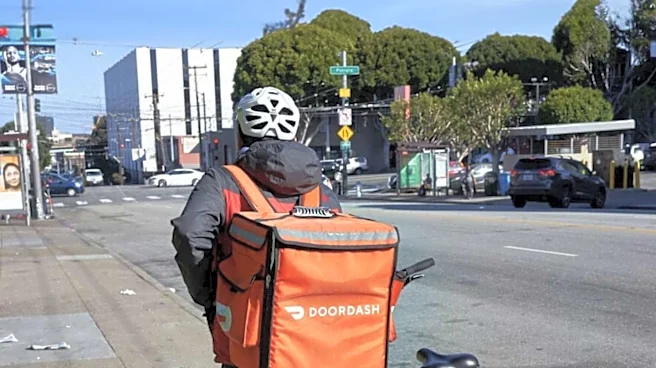
DoorDash co-founder and CEO Tony Xu announced that third-party AI agents have generated only 'several hundred orders' on its platform since the introduction of its Model Context Protocol (MCP) connector less than a month ago. This figure represents a 'very
low use case' compared to the nearly 1 billion total orders DoorDash processed in the third quarter of 2026 alone. The MCP connector was designed to provide a standardized, open-standard method for external AI tools to integrate and place orders through DoorDash's platform. Currently, this connector is accessible to a limited number of 'early beta partners' and is primarily utilized for streamlining corporate lunch orders. Prior to the MCP, AI agents had to navigate DoorDash via web interfaces, requiring more effort. Xu noted that while AI agents might be beneficial for 'long consideration purchases,' tasks as simple as ordering food tend to be handled directly by users on the DoorDash app.
Why It's Important?
This development highlights the current limitations and adoption challenges of AI agents in consumer-facing services, particularly for routine tasks. Despite significant investment and industry buzz around AI integration, DoorDash's experience suggests that consumers are not yet widely embracing AI agents for everyday activities like food delivery. This could influence how other companies approach AI integration, potentially shifting focus from simple transactional tasks to more complex, 'long consideration' purchases where AI can genuinely add value by performing background work. For DoorDash, the low uptake indicates that their core business model remains largely unaffected by AI agent adoption, reinforcing the direct user-to-platform interaction. It also suggests that the perceived convenience of AI agents may not outweigh the simplicity of direct app usage for quick, low-stakes decisions.
What's Next?
DoorDash will likely continue to monitor the adoption of its MCP connector and gather data from its 'early beta partners.' The company may refine its AI integration strategy based on user feedback and evolving AI capabilities, potentially exploring more complex use cases where AI agents can offer distinct advantages beyond simple order placement. Other food delivery platforms and e-commerce companies will likely observe DoorDash's experience to inform their own AI integration efforts. The slow initial adoption might lead to a re-evaluation of the immediate market readiness for AI agents in certain consumer sectors, prompting a more gradual rollout or a pivot towards enterprise solutions rather than direct consumer applications for AI agents in the short term.
Beyond the Headlines
The minimal adoption of AI agents for DoorDash orders raises broader questions about the practical utility and user acceptance of AI in daily life. While AI technology is rapidly advancing, its integration into consumer behavior is not always straightforward. This situation could indicate a gap between technological capability and actual user need or perceived value for simple tasks. It also touches upon the psychological aspect of human-computer interaction; users might prefer direct control over their immediate needs rather than delegating them to an AI, especially when the task is quick and familiar. This could prompt a deeper examination into what types of tasks consumers are truly willing to entrust to AI agents, pushing developers to focus on more sophisticated problem-solving rather than automating already simple processes.