






What's Happening?
The U.S. manufacturing industry is undergoing a significant transformation driven by substantial investments from private companies, the federal government, and foreign donors, with the sector accounting for over 50% of private-sector research and development
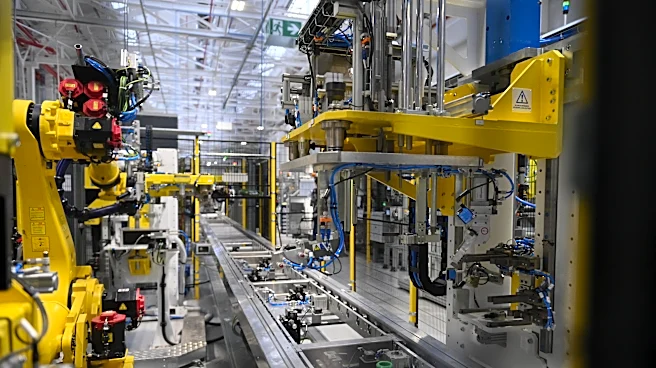
in the U.S. According to Ilya Kovalenko, assistant professor at Penn State, this investment is fueling the rapid development of artificial intelligence (AI) and robotics to improve factory safety and efficiency. Manufacturers are increasingly exploring custom automation systems and humanoid robotics to address a critical need for more trained workers and to make human work safer, faster, and more cost-efficient by automating 'dull, dirty, and dangerous' jobs. AI is also being utilized to enhance product flexibility and adaptability in manufacturing, allowing production systems to dynamically change behavior and produce goods more efficiently.
Why It's Important?
This evolution in American manufacturing is vital for several reasons. Firstly, it directly addresses the shortage of skilled workers, allowing facilities to maintain and even increase output despite personnel constraints. Secondly, by automating hazardous tasks, AI and robotics significantly improve workplace safety, protecting human workers from toxic chemicals and dangerous processes. Thirdly, the focus on flexibility and adaptability, enabled by AI, allows U.S. manufacturers to respond more quickly to customer demands and market changes, which is crucial for competitiveness. This modernization effort is also key to 'reshoring' manufacturing, bringing production back to the U.S. after decades of reliance on overseas facilities, thereby strengthening domestic supply chains and economic resilience.
What's Next?
The U.S. manufacturing sector is expected to continue its trajectory of integrating advanced AI and robotics. This will involve ongoing industrial and workforce research to help U.S. manufacturers, particularly smaller 'mom-and-pop' shops, catch up with global competitors. The development of robots and tools designed to automate and optimize facilities by taking over repetitive and mundane tasks will be a key focus. Future research will likely explore new possibilities in areas such as 3D printing for large structures, small-scale fabrication techniques for semiconductors, and modernizing foundries. The emphasis will remain on creating safer, more collaborative systems that effectively integrate human workers with advanced automated technologies.
Beyond the Headlines
The embrace of AI and robotics in manufacturing signifies a broader shift in industrial strategy, moving towards a more resilient and technologically advanced production ecosystem. This transformation has profound implications for the U.S. economy, potentially leading to a resurgence in domestic manufacturing capabilities and a reduction in reliance on foreign supply chains. However, it also necessitates a proactive approach to workforce development, ensuring that current and future workers possess the skills required to operate and maintain these advanced systems. The ethical considerations surrounding job displacement and the need for equitable access to training and new opportunities will be ongoing challenges that policymakers and industry leaders must address to ensure a just transition.