





What's Happening?
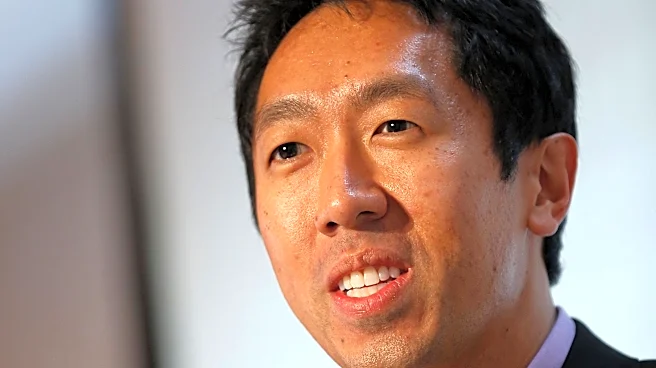
Noam Brown, a research scientist at OpenAI, asserts that even the most advanced AI models, including the latest 'Astra,' are currently unable to independently build a full-scale poker bot. Brown, who previously developed poker bots that surpassed human
players, uses this as a benchmark to illustrate the 'spiky' nature of AI intelligence. He notes that while newer models like GPT-5.5 and 5.6 significantly enhance his ability to construct a bot, they still require human intervention. Brown's experience indicates that AI excels in specific tasks, such as generating an excellent river solver from a single prompt, but lacks the comprehensive judgment and long-term planning capabilities needed for complex, real-world applications like a complete poker bot. This observation stems from his professional shift from computational game theory to training AI on human data, recognizing that human irrationality and behavior are crucial for developing more general intelligence.
Why It's Important?
Brown's insights are critical for understanding the current state and future direction of AI development, particularly in the U.S. technology sector. His emphasis on the 'spiky' nature of AI intelligence highlights that while AI can achieve superhuman performance in narrow domains, it still has significant gaps in areas requiring nuanced human judgment, long-term planning, and the ability to identify when a strategy is failing. This perspective challenges the notion that larger pre-trained models alone will solve all AI challenges, suggesting that human expertise remains indispensable in guiding and refining AI applications. For businesses and industries, this means that AI is best utilized as a tool to augment human capabilities rather than replace them entirely, fostering a 'centaur period' where human-AI collaboration yields superior results. This understanding can influence investment strategies, workforce development, and the ethical deployment of AI technologies across various sectors.
What's Next?
The ongoing development in AI will likely focus on bridging the gaps identified by Brown, particularly in areas of long-term planning, organizational capabilities, and the ability to self-correct. Future research may explore alternative approaches to 'chain-of-thought' reasoning, which, while effective, may not fully capture diverse human thought processes. The 'centaur period' described by Brown suggests a continued emphasis on human-AI collaboration, where humans leverage AI's strengths for specific tasks while providing the overarching judgment and strategic direction. This could lead to the development of more sophisticated AI tools that are better integrated into human workflows, requiring a workforce skilled in both AI operation and critical thinking. The insights also imply that the U.S. AI industry will continue to invest in understanding human data and behavior to create more robust and adaptable AI systems, moving beyond purely rational game-theoretic models.
Beyond the Headlines
Brown's journey from computational game theory to human-data-driven AI development reveals a deeper philosophical shift in the understanding of intelligence itself. His realization that 'rationality' is not always the optimal assumption when modeling human behavior has profound implications for how AI is designed to interact with the real world. This perspective suggests that AI's true potential lies not just in processing vast amounts of data or executing complex algorithms, but in its ability to understand and adapt to the complexities of human interaction, including irrationality, fairness, and vengeance. This has ethical and societal implications, as AI systems designed with this understanding could be more empathetic, less prone to bias, and better equipped to navigate social dynamics. It also underscores the ongoing debate about the nature of general intelligence and whether it can be achieved through purely computational means or if it inherently requires an understanding of human-like consciousness and experience.