








What's Happening?
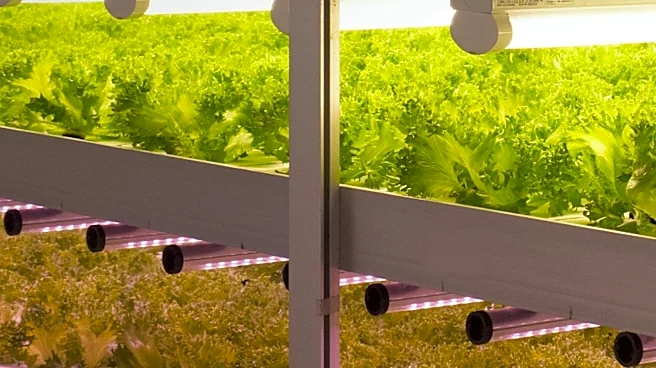
Saffron Box Inc., a Canadian agritech company, is currently in an R&D and unit-economics validation phase for its indoor saffron cultivation. The company has expanded its operations from a garage pilot to a barn near Calgary, where it is growing 40,000
saffron corms in a vertical indoor system. Additionally, 20,000 corms have been planted outdoors in British Columbia to compare production performance. This dual-province trial aims to establish yields, production costs, and quality benchmarks before the company commits to commercial expansion. Vikash Sangwan, Founder and CEO of Saffron Box Inc., emphasizes the importance of validating unit profitability at the pod level for sustainable Controlled Environment Agriculture (CEA) enterprises. The immediate focus is on recording dry-stigma output from the indoor crop to determine yield per square meter and the fully loaded cost per dry gram. Thermal conditioning, including HVAC and humidity regulation, is identified as the largest recurring operating expense, especially during sub-zero Prairie winters, followed closely by harvest labor.
Why It's Important?
This initiative is significant for the agricultural sector, particularly in regions with challenging climates like the Canadian Prairies, as it explores the economic viability of high-value crops like saffron through indoor farming. By meticulously validating unit profitability and optimizing production processes, Saffron Box Inc. could pave the way for more sustainable and resilient agricultural practices. Success in this venture could reduce reliance on imported saffron, create new agricultural jobs, and diversify local economies. The detailed analysis of operational costs, especially thermal conditioning and labor, provides crucial data for future CEA projects, helping to mitigate financial risks for investors and entrepreneurs in the agritech space. Furthermore, demonstrating the ability to grow saffron in controlled environments could inspire similar ventures for other specialty crops, enhancing food security and local food production capabilities.
What's Next?
Saffron Box Inc. plans to continue its validation phase, focusing on stress-testing its hardware architecture, benchmarking real-world winter utility loads, optimizing harvest labor workflows, and solidifying off-take extraction partnerships. The company aims to raise pre-seed capital to fund its first commercial fleet, with a long-term goal of achieving 100 kilograms of annual saffron production. Its proposed operating model involves moving staggered batches of corms through dedicated flowering rooms, targeting three to four flowering cycles annually within the same structural footprint. The company is also developing a modular concept based on 53-foot refrigerated trailers for future deployment, designed to accommodate over 50,000 corms per unit. Initial target customers include regional hospitality businesses, confectioners, and craft distillers, with long-term plans to supply standardized extracts to functional food, cosmetic, and nutraceutical manufacturers.
Beyond the Headlines
The efforts by Saffron Box Inc. highlight a broader trend in agriculture towards precision environmental control and the decoupling of crop production from seasonal climate constraints. This approach has profound implications for food systems, offering potential solutions to challenges posed by climate change, land scarcity, and the need for consistent, high-quality produce. The company's focus on validating unit economics before scaling reflects a maturing agritech industry, where profitability and sustainability are becoming paramount. This meticulous approach could set a new standard for agricultural startups, emphasizing data-driven decision-making and rigorous financial planning. Furthermore, the development of modular, container-based farming solutions could democratize access to advanced agricultural technologies, enabling localized production of specialty crops in diverse geographical locations, thereby reducing supply chain vulnerabilities and promoting regional economic development.