
What's Happening?
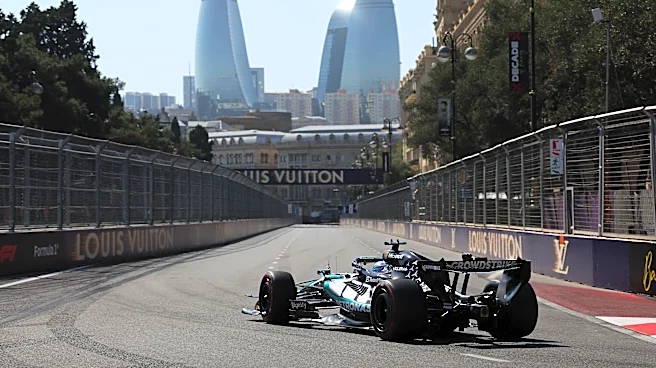
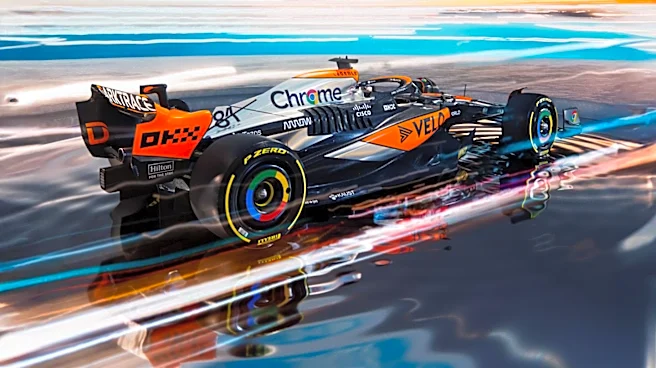
Oscar Piastri secured third position in qualifying for the Azerbaijan Grand Prix, placing him behind pole-sitter George Russell and second-placed Charles Leclerc. Despite McLaren's improved performance
during qualifying, Piastri noted a significant gap to Russell, who was 0.838 seconds faster. Russell had dominated most sessions throughout the Baku weekend, underscoring Mercedes' strong form. Piastri's third-place qualifying matches his best result of the season, previously achieved in Japan and Italy. He acknowledged that while McLaren's car 'comes alive' more in qualifying with less fuel, they are still considerably behind Mercedes. Teammate Lando Norris, who qualified fifth, also expressed concerns about McLaren's straight-line speed, suggesting it would make a podium finish challenging.
Why It's Important?
This qualifying result highlights the competitive dynamics within Formula 1, particularly the fluctuating performance between top teams like McLaren and Mercedes. For McLaren, securing a third-place start for Piastri indicates a positive step in their qualifying pace, suggesting they can extract more performance from their car under specific conditions. However, the substantial time gap to Mercedes' George Russell underscores a persistent challenge in matching the absolute pace of leading competitors. This performance disparity, especially in straight-line speed as noted by Norris, could be a critical factor in the race, potentially limiting McLaren's ability to contend for victory or even podium positions against faster rivals. The outcome of this race will offer further insights into the development trajectories of these teams and their championship aspirations.
What's Next?
The Azerbaijan Grand Prix is scheduled to begin, with Oscar Piastri starting from third position. The race will test McLaren's ability to convert their qualifying performance into a strong race result, particularly given their acknowledged disadvantage in straight-line speed compared to Mercedes. Piastri expressed hope for a podium but tempered expectations due to this speed deficit. The team will likely focus on strategic decisions and tire management to compensate for any performance gaps. The race will also reveal whether Mercedes can maintain its dominant pace and if other teams, like Ferrari with Charles Leclerc, can challenge for the lead. The performance in Baku will be crucial for understanding the competitive landscape as the Formula 1 season progresses.
Beyond the Headlines
The qualifying results in Baku, particularly the significant gap between McLaren and Mercedes, point to deeper engineering and aerodynamic challenges within Formula 1. McLaren's struggle with straight-line speed, despite improved qualifying pace, suggests a trade-off in car design that prioritizes cornering ability over outright velocity on straights. This strategic choice can be a double-edged sword, offering advantages on technical circuits but hindering performance on tracks with long straights like Baku. The ongoing development battle between teams involves complex decisions about car philosophy, engine integration, and aerodynamic efficiency. These choices have long-term implications for team competitiveness, driver performance, and championship aspirations, influencing resource allocation and future car designs. The continuous pursuit of optimal balance between speed, downforce, and tire degradation remains a core challenge in modern Formula 1.