





What's Happening?
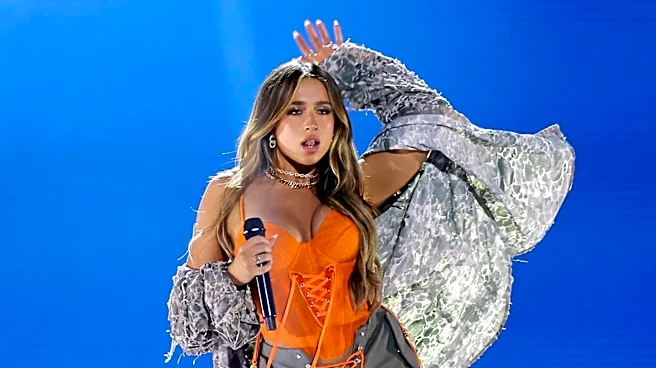
Tate McRae's new song 'Housewife' has become a viral sensation on TikTok, but its meaning is being widely reinterpreted by users. The song's hook, 'I just wanna make a lot of money, be my own housewife,' was intended by McRae as a statement of independence,
with her music video depicting her lounging on a yacht, symbolizing self-sufficiency. However, a significant portion of TikTok creators, particularly those identifying as 'trad wives,' are using the song to promote traditional gender roles, with some even altering the on-screen lyrics to 'be my man's housewife.' This reinterpretation has led to a debate on the platform, with other creators posting videos to clarify the song's original feminist message, highlighting the irony of its co-option. The song's popularity on TikTok has contributed to its commercial success, debuting at No. 2 on the Hot 100, McRae's highest-charting song as a lead artist.
Why It's Important?
This phenomenon highlights the dynamic and often unpredictable nature of content virality on social media platforms like TikTok. Artists and marketers are increasingly facing a landscape where the intended message of a song or creative work can be recontextualized and even inverted by user-generated content. This can lead to both increased exposure and potential misrepresentation of an artist's message. For the music industry, it underscores the importance of understanding how a song's 'hook' can be interpreted and re-used by diverse audiences. The debate surrounding 'Housewife' also reflects broader societal discussions about gender roles and independence, demonstrating how popular culture can become a battleground for differing ideologies. The song's success, despite or perhaps because of these conflicting interpretations, suggests that controversy and active user engagement, even if it involves misinterpretation, can drive significant reach and chart performance.
What's Next?
The ongoing debate around 'Housewife' on TikTok is likely to continue, with creators from both sides of the interpretation spectrum producing more content. This sustained engagement could further boost the song's visibility and streaming numbers. For Tate McRae and her marketing team, the challenge will be to navigate this dual narrative. They may choose to 'stay above it,' allowing the song to speak for itself, or 'wink at it' with playful content that acknowledges both interpretations without taking a definitive side. A more direct 'correction' of the misinterpretation could risk alienating a segment of the audience that is contributing to the song's virality. The situation also provides a case study for other artists and labels on how to anticipate and potentially leverage diverse interpretations of their work in the highly interactive social media environment.
Beyond the Headlines
The 'Housewife' trend on TikTok reveals a deeper cultural phenomenon where artistic intent can diverge significantly from audience reception, especially in a participatory media landscape. The platform's emphasis on user-generated content means that a song's meaning is not solely determined by its creator but is collectively shaped by its users. This can lead to a democratization of meaning, where a song becomes a template for individual expression, even if that expression contradicts the original message. The 'trad wife' reinterpretation of 'Housewife' also points to the enduring presence and re-emergence of traditional values within contemporary digital spaces, often clashing with more progressive narratives. This dynamic interplay between original intent, user interpretation, and cultural values highlights the complex ethical and cultural dimensions of content creation and consumption in the age of social media.