


What's Happening?
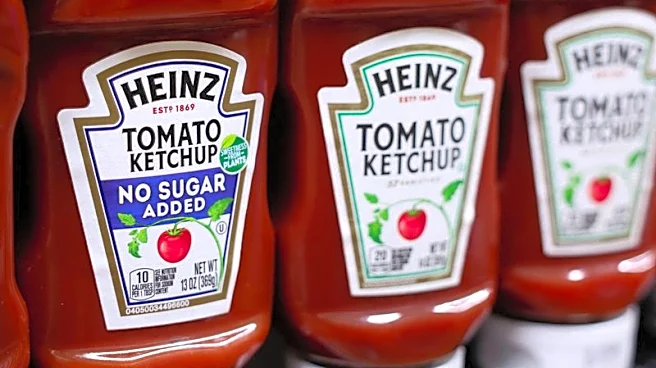
Kraft Heinz Co. (KHC) is maintaining its annual dividend at $1.60 per share, a rate it has held since 2020. This decision comes despite a 1.1% decline in organic net sales in the third quarter of 2026 compared to the previous year. The company, however,
raised its 2026 adjusted EPS guidance to a range of $2.07 to $2.13, up from $2.03 to $2.09. While free cash flow (FCF) fell short of dividend payments in 2022, it has since comfortably covered the dividend, with $3.66 billion in FCF against $1.90 billion paid in 2025. For the twelve months ending June 27, 2026, the dividend consumed 50% of FCF. Analysts project this figure to rise to 64% in 2026, as FCF is expected to decrease by 19% from 2025. Kraft Heinz plans to spend an additional $700 million on brand investment, which is contributing to an anticipated 16% to 18% decline in adjusted operating income in constant currency.
Why It's Important?
The stability of Kraft Heinz's dividend is a critical factor for income-focused investors, particularly retirees who rely on consistent payouts. The company's commitment to sustaining its $1.60 dividend, even while facing declining organic sales and investing heavily in its brands, signals a strategic balance between shareholder returns and long-term growth initiatives. The projected increase in the dividend payout ratio to 64% in 2026, due to an expected 19% drop in free cash flow, indicates a tighter financial position for dividend coverage compared to previous years. This could raise concerns among some investors about the sustainability of future dividend increases, although the company has explicitly listed dividend sustenance as a priority alongside business investment and debt reduction. The $700 million reinvestment strategy is crucial for revitalizing its brand portfolio and potentially driving future sales growth, which is essential for the company's long-term financial health and its ability to continue supporting its dividend.
What's Next?
Kraft Heinz is expected to continue prioritizing its dividend, brand investments, and debt reduction. The company's guidance for adjusted operating income to decrease by 16% to 18% in constant currency for 2026 reflects the impact of its increased spending on brands. Investors will closely monitor the company's financial performance, particularly its free cash flow generation and organic net sales, to assess the long-term sustainability of its dividend and the effectiveness of its brand reinvestment strategy. Future earnings reports and management commentary will provide further insights into whether the strategic investments are yielding the desired results in terms of sales growth and improved profitability, which are vital for maintaining dividend stability and potentially enabling future increases.
Beyond the Headlines
The situation at Kraft Heinz highlights a common challenge for mature consumer staples companies: balancing shareholder expectations for consistent dividends with the need for significant investment to remain competitive and drive growth in a dynamic market. The company's decision to maintain its dividend while simultaneously undertaking substantial brand reinvestment suggests a strategic pivot towards long-term value creation, even if it means a temporary squeeze on free cash flow and operating income. This approach could be a double-edged sword; successful brand revitalization could lead to sustained growth and stronger dividend coverage in the future, while a failure to generate sufficient returns from these investments could put further pressure on its financial health. The emphasis on debt reduction alongside these initiatives also points to a broader strategy of strengthening the balance sheet to provide more flexibility for future growth and shareholder returns.