





What's Happening?
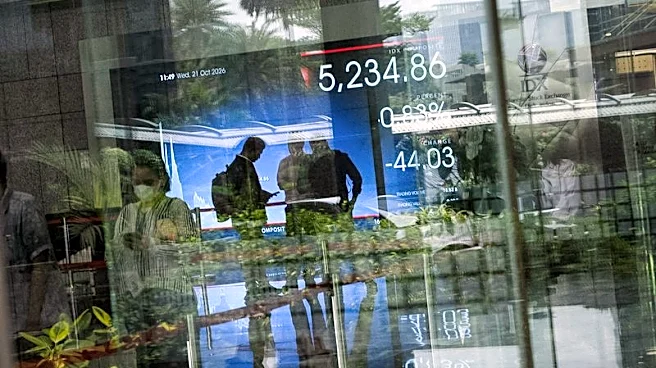
Following the S&P 500's 4.4% drop and the Nasdaq 100's 6.5% fall, marking the worst day for the S&P 500 since April 2025, Warren Buffett's investment philosophy is being revisited, particularly for retirees. For a 65-year-old with $800,000 in retirement
savings, 60% in stocks, this single-day decline meant a loss of approximately $21,000. Buffett's advice, famously articulated in 2008 during a market downturn, is to 'Be fearful when others are greedy, and be greedy when others are fearful.' While he acknowledged the inability to predict short-term market movements, he maintained that stocks would be higher in the long run. However, for retirees, Buffett's 2013 advice to his wife's trustee is more pertinent: invest 90% in a low-cost S&P 500 index fund and 10% in short-term government bonds. The 10% bond allocation serves as a crucial buffer, ensuring that retirees do not have to sell stocks during market downturns to cover living expenses.
Why It's Important?
Buffett's guidance offers a critical framework for retirees facing market volatility, emphasizing the importance of a diversified portfolio that includes a cash buffer. This strategy directly addresses the unique challenge retirees face: needing to draw income from their investments while also preserving capital. Without a sufficient bond or cash allocation, retirees might be forced to sell equities at a loss during market downturns, significantly impacting their long-term financial security. The recent market drop underscores the immediate relevance of this advice, as it highlights how quickly a substantial portion of a retirement portfolio can seemingly vanish. Implementing such a strategy can provide peace of mind and financial resilience, allowing retirees to adhere to a long-term investment plan without succumbing to panic selling.
What's Next?
Retirees and financial advisors are likely to re-evaluate portfolio allocations, with a potential emphasis on increasing the allocation to short-term bonds or cash to create a more robust spending cushion. This could lead to a shift in asset allocation strategies for retirement planning, prioritizing liquidity and stability over maximizing equity returns, especially for those nearing or in retirement. Financial institutions may also promote more conservative portfolio models that incorporate Buffett's recommended bond allocation. For those who currently lack such a buffer, the recent market dip serves as a stark reminder to adjust their portfolios to better withstand future volatility, potentially by rebalancing or gradually increasing their fixed-income holdings.
Beyond the Headlines
The discussion around Buffett's advice for retirees delves into the psychological aspects of investing during market stress. The instinct to sell during a downturn is powerful, but Buffett's strategy provides a practical mechanism to counteract this emotional response. It highlights the difference between an investor's ability to wait out market fluctuations (like Buffett) and a retiree's need for immediate income. This distinction underscores the need for personalized financial planning that accounts for individual circumstances, risk tolerance, and time horizons. Furthermore, it implicitly critiques a purely growth-oriented investment approach for retirees, advocating for a more balanced strategy that prioritizes capital preservation and income stability, thereby influencing broader discussions on responsible retirement planning and financial literacy.