





What's Happening?
Runway, an AI video model company, has released Praxis-1, an open-weight world action model designed to enable robots to learn physical tasks through large-scale video training. The model, originally introduced in September, is now publicly available
under the Apache 2.0 license, allowing researchers and developers to utilize it for both commercial and research applications. Praxis-1 is a 27-billion-parameter model that integrates video prediction with robot action generation, allowing robots to anticipate environmental changes during task execution. Unlike traditional methods that rely heavily on robot-specific training data, Praxis-1 leverages general video footage to teach robots about object behavior and interaction before adapting to specific robotic systems. Runway reports that Praxis-1 achieved a 46.2 percent success rate on Nvidia’s RoboLab-120 benchmark, outperforming other open-weight robot foundation models.
Why It's Important?
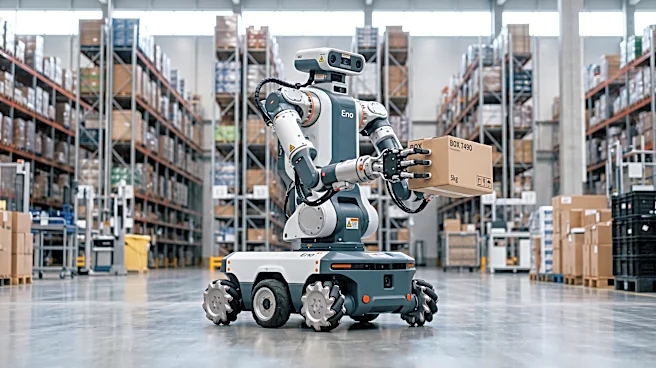
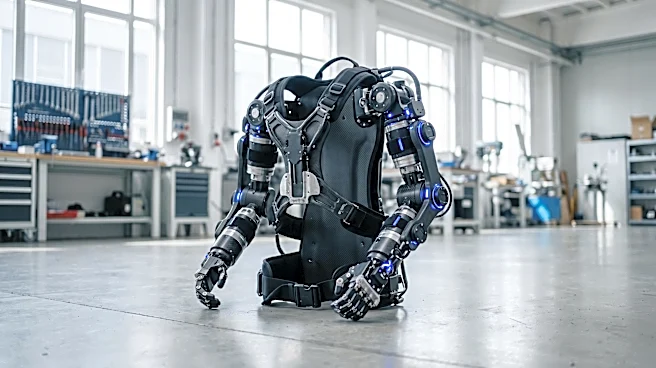
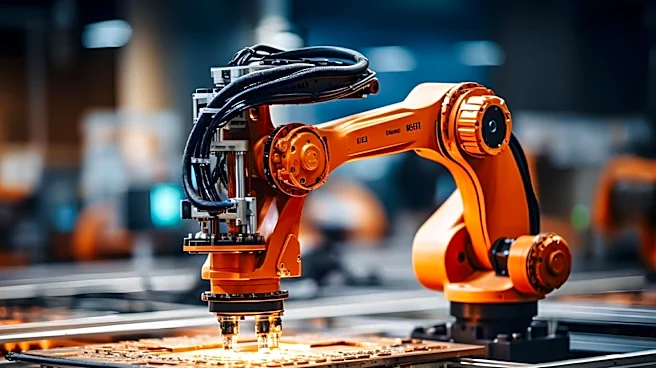
The release of Praxis-1 marks a significant step in making advanced robotic manipulation more accessible and cost-effective. By reducing the dependence on expensive, robot-specific training datasets, this open-weight model could accelerate innovation in robotics across various industries. The ability to adapt the same underlying model to different robotic configurations, including industrial arms, dual-arm warehouse robots, and humanoid systems, suggests a versatile tool that could streamline development and deployment. This could lead to more efficient automation in manufacturing, logistics, and other sectors, potentially transforming supply chains and operational efficiencies. However, the model's current limitations, such as struggles with visually similar objects and complex multi-step tasks, indicate that human oversight and further refinement will remain crucial. The open-source nature of Praxis-1 also fosters collaborative development, potentially leading to rapid improvements and wider adoption within the robotics community.
What's Next?
Runway has made the model's weights, inference software, and fine-tuning tools available through GitHub and Hugging Face, with support for the LeRobot framework, encouraging widespread adoption and further development by the robotics community. The company acknowledges current limitations, including difficulties with visually similar objects, ambiguous instructions, and complex tasks requiring multiple sequential actions. Runway plans to conduct further research into long-term reasoning, autonomous planning, and the development of self-improving world action models to address these challenges. Development partners, including Noble Machines, Standard Bots, and Ultra, are already utilizing Praxis-1, suggesting its immediate application in various robotic systems. The open-source nature of the model is expected to foster rapid advancements and broader integration into diverse robotic applications.
Beyond the Headlines
The introduction of Praxis-1, with its reliance on large-scale video training, highlights a broader trend in AI development: the shift towards models that learn from vast, generalized datasets rather than narrowly focused, domain-specific ones. This approach could democratize access to advanced AI capabilities, allowing smaller companies and research institutions to develop sophisticated robotic systems without the prohibitive costs associated with bespoke data collection. However, it also raises questions about the ethical implications of training robots on general video footage, including potential biases embedded in the data and the challenges of ensuring safe and predictable behavior in real-world scenarios. The ongoing development of such models will necessitate careful consideration of how to instill robust safety protocols and ethical guidelines, particularly as robots become more autonomous and integrated into daily life. The balance between rapid innovation and responsible deployment will be a critical challenge for the robotics industry.