



What's Happening?
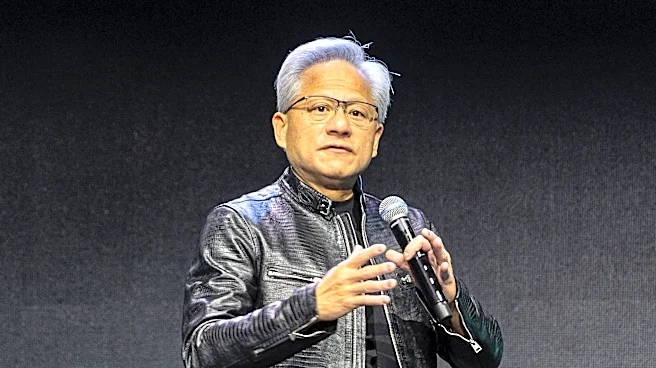
NVIDIA CEO Jensen Huang recently addressed the ongoing discussion surrounding open and closed AI models, stating that NVIDIA sees a place for both approaches. Speaking at Fireworks Forge in San Francisco, Huang indicated that NVIDIA is not concerned with
which model type ultimately prevails, as long as its hardware powers the underlying infrastructure. He acknowledged the value of 'closed frontier models' while also highlighting the potential of open models, particularly when adapted with specialized knowledge to create 'superintelligence.' Huang emphasized that most of the world's value is captured by specialized intelligence, which refers to AI models trained on specific domains of knowledge. He also noted that the significant breakthrough of the past year has been the development of agent harnesses that transform AI models into agents, and predicted that 'hardware in the loop,' or robotic systems, will be the next major industry breakthrough.
Why It's Important?
Jensen Huang's statements provide insight into NVIDIA's strategic positioning within the evolving AI landscape. By embracing both open and closed AI models, NVIDIA ensures its continued relevance and market dominance, as its core business revolves around providing the essential hardware for AI development and deployment. This stance is crucial for U.S. technology companies and the broader AI industry, as it suggests a future where diverse AI development paths can coexist, each relying on powerful computing infrastructure. The emphasis on specialized intelligence highlights a potential shift in AI investment and application, moving towards highly tailored solutions for specific industries rather than a singular focus on general AI. This could drive innovation in various sectors, from healthcare to manufacturing, as companies seek to leverage AI for domain-specific challenges. Furthermore, Huang's prediction about 'hardware in the loop' and robotic systems signals a significant growth area for the U.S. tech sector, potentially leading to increased research, development, and manufacturing in advanced robotics and autonomous systems.
What's Next?
NVIDIA's continued support for both open and closed AI models suggests that the company will likely maintain its focus on developing and supplying high-performance GPUs and related hardware to a broad spectrum of AI developers and enterprises. This approach will enable NVIDIA to capitalize on the growth of both proprietary and open-source AI initiatives. The increasing recognition of specialized intelligence will likely lead to more targeted AI development, with companies investing in models tailored to their specific needs and data. This could foster a more competitive and diverse AI market. The anticipated breakthrough in 'hardware in the loop' and robotic systems indicates a future where AI is increasingly integrated into physical devices and real-world applications. This will drive demand for advanced sensors, actuators, and embedded AI systems, creating new opportunities for hardware manufacturers and software developers in the U.S. and globally. The development of agent harnesses, as highlighted by Huang, will also continue to evolve, making AI models more autonomous and capable of complex tasks.
Beyond the Headlines
Huang's pragmatic approach to open versus closed AI models, prioritizing hardware infrastructure, subtly underscores the foundational role of computing power in the AI era. This perspective suggests that while the philosophical debate around AI openness continues, the practical reality is that powerful hardware remains indispensable, regardless of the model's accessibility. This could lead to a concentration of power in the hands of hardware providers, raising questions about potential bottlenecks and dependencies in the global AI supply chain. The focus on specialized intelligence, while economically rational, might also inadvertently steer AI development away from broader, more generalizable solutions that could address complex societal challenges. The rise of 'hardware in the loop' and robotic systems, while promising for industrial advancement, also brings forth ethical dilemmas concerning automation's impact on human employment, safety, and the increasing autonomy of machines in critical functions. The long-term implications include a potential redefinition of human-machine collaboration and the need for robust regulatory frameworks to govern increasingly intelligent and autonomous physical systems.