







What's Happening?
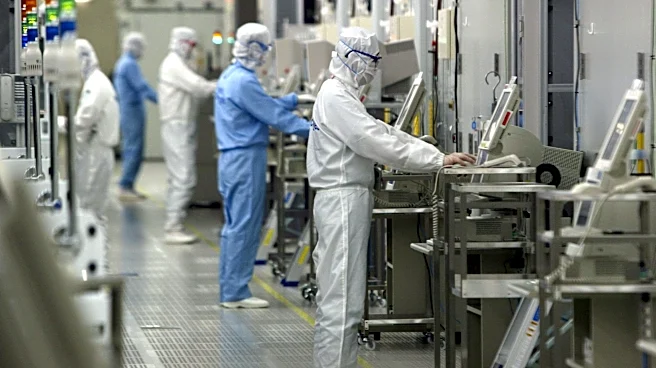
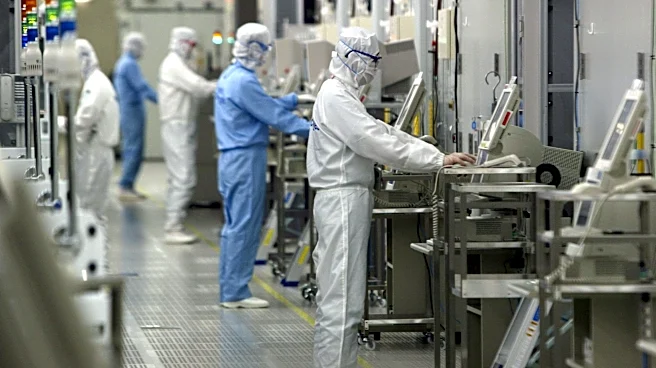
Lam Research, a company specializing in etch and deposition machines crucial for advanced chip manufacturing, has demonstrated significant financial performance. The company reported a 54.4% year-over-year revenue growth in its most recent quarter and 33.3%
over the trailing twelve months. This growth is largely attributed to increased investment in memory and advanced chip stacking, driven by the ongoing artificial intelligence (AI) build-out. Memory, particularly high-bandwidth memory (HBM) which involves stacking DRAM dies, constituted 46% of Lam Research's systems revenue last quarter. Management anticipates industry equipment spending to exceed $200 billion by 2027, with DRAM leading this expenditure. Despite a recent dip in share price, 85.7% of analysts rate Lam Research as a 'Buy,' and it was held by 122 hedge funds at the end of the third quarter.
Why It's Important?
Lam Research's performance highlights the critical role of semiconductor equipment manufacturers in the current technological landscape, particularly with the rapid expansion of AI. The resurgence in memory makers' spending, after a period of caution, signals a robust demand for advanced chips. This trend benefits companies like Lam Research, which provide essential tools for creating complex chip architectures. The company's strong revenue growth indicates a healthy demand for its specialized equipment, which is integral to producing the high-performance chips required for AI applications. However, the cyclical nature of the chip equipment industry and Lam Research's significant exposure to the Chinese market (35% of revenue last quarter) present potential vulnerabilities, especially with tightening export regulations. The company's ability to navigate these geopolitical and market fluctuations will be crucial for its sustained growth.
What's Next?
Lam Research's future growth is heavily dependent on the continued spending by memory makers throughout the current cycle. While the AI build-out is a significant driver, the cyclicality of the chip equipment sector means that memory spending can abruptly halt if market prices shift. The company also faces ongoing challenges from tightening export rules, particularly concerning its substantial revenue from Chinese domestic customers, which management expects to decline significantly in the upcoming quarter. Investors will be closely watching how Lam Research manages these headwinds and whether its technological strengths in advanced chip manufacturing can cushion the impact of market volatility and geopolitical pressures. The company's ability to adapt to evolving export regulations and maintain its market position in a highly competitive and sensitive industry will be key to its performance in 2027 and beyond.
Beyond the Headlines
The trajectory of Lam Research reflects broader trends in the global technology sector, where the demand for advanced computing power, particularly for AI, is reshaping supply chains and investment priorities. The company's reliance on memory and advanced chip stacking underscores the increasing complexity and specialization within semiconductor manufacturing. This also brings to light the intricate balance between technological innovation and geopolitical realities, as export controls and international trade policies directly impact the operations and revenue streams of major tech players. The situation with Lam Research and its exposure to China highlights the ongoing tension between globalized supply chains and national security concerns, forcing companies to re-evaluate their market strategies and diversify their operations. The long-term implications could include a more fragmented global semiconductor industry, with companies potentially developing region-specific manufacturing capabilities to mitigate geopolitical risks.