






What's Happening?
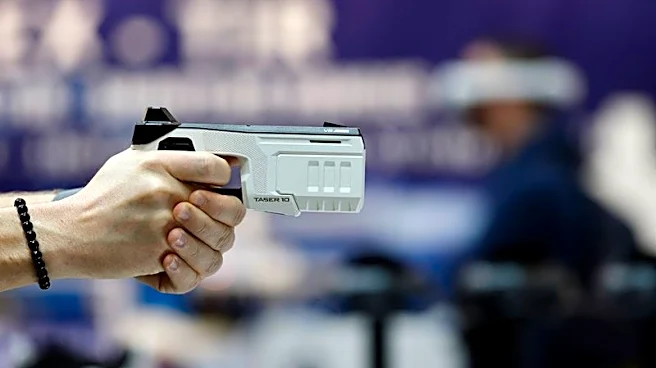
Axon Enterprise, known for its Taser electrical weapons and body cameras, experienced an 18% drop in its stock price on Friday, reaching its lowest point in over two years. This significant decline followed the company's third-quarter earnings report,
which revealed a substantial revenue miss and a downward revision of its fourth-quarter guidance. Axon reported Q3 revenue of $908.6 million, falling short of the $934.3 million consensus. For Q4, the company projected revenue between $990 million and $1.01 billion, indicating a 25% growth, which is the slowest since late 2021 and below the $1.07 billion consensus. The revenue shortfall was primarily attributed to a delayed $30 million Federal Dedrone deployment, which was expected in Q3 but was pushed out. Additionally, the company cut its free cash flow guidance for the year from $450 million to $350 million-$400 million due to accelerated inventory growth.
Why It's Important?
This sharp decline in Axon's stock price highlights investor sensitivity to revenue performance and future guidance, even when delays are cited as the primary cause. The company's explanation that the revenue miss was due to a timing issue rather than weak demand did not fully assuage investor concerns, as evidenced by the stock's plunge. The downgrade by Craig-Hallum to neutral, citing weak Taser performance and volatility in federal contracts, further underscores the market's apprehension. While CFO Joshua Isner emphasized strong demand in other parts of the business, the immediate market reaction indicates that investors prioritize consistent financial delivery and clear guidance. This event could impact Axon's ability to secure future federal contracts or influence its stock valuation in the short to medium term, affecting its market capitalization and investor confidence.
What's Next?
Axon's management will likely face increased scrutiny regarding its financial forecasting and the timing of large federal contracts. The company's strategy to improve product availability and supply chain resilience through accelerated inventory growth will be closely watched to see if it yields positive results in future quarters. The introduction of Taser Ion, a new and more flexible Taser device, is expected to boost sales and could be a key factor in the company's recovery. Investors will be looking for signs of improved revenue recognition and more stable performance in federal contracts. The company's ability to regain investor confidence will depend on its execution in the coming quarters and its capacity to deliver on revised guidance, potentially leading to a re-evaluation of its stock by analysts and the market.
Beyond the Headlines
The challenges faced by Axon Enterprise, particularly with federal contracts, reflect broader issues that technology companies serving government sectors can encounter. The 'lumpy one-time revenue payments' and 'timing-sensitive hardware' mentioned by management point to the inherent unpredictability and long sales cycles often associated with government procurement. This volatility can create significant swings in financial performance and investor perception, even for companies with strong underlying demand. For Axon, a company deeply integrated with law enforcement technology, these financial fluctuations can also indirectly influence public perception and policy discussions surrounding the procurement and deployment of such technologies. The need for more conservative guidance and clearer communication from management suggests a learning curve in navigating these complex market dynamics.