








What's Happening?
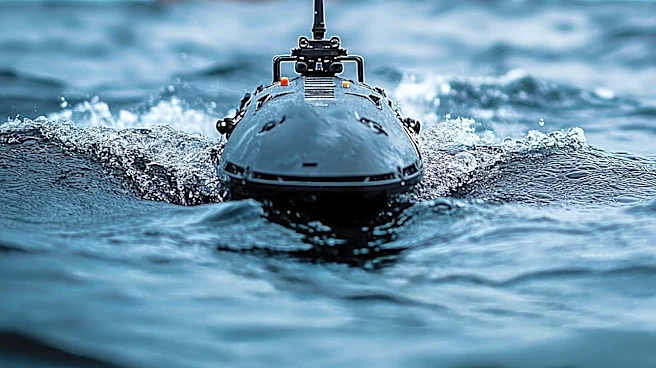
Saronic has launched a new 52-ft. Autonomous Surface Vessel (ASV) named 'Mirage', expanding its fleet of autonomous maritime platforms. The vessel, which joins the 24-ft. Corsair and 180-ft. Marauder, is designed to enhance the capabilities of both manned
and unmanned maritime operations. Mirage boasts a top speed of over 35 knots, a range exceeding 2,500 nautical miles, and a payload capacity of 3,500 pounds. It operates autonomously or under remote supervision via Saronic's Echelon command-and-control platform. The vessel's modular architecture allows for the integration of various hardware and software solutions, making it adaptable for different missions. The first Mirage hull has begun on-water trials at Saronic's test facility in Galveston, Texas.
Why It's Important?
The launch of Mirage represents a significant advancement in autonomous maritime technology, potentially transforming maritime operations by providing enhanced capabilities for surveillance, security, and detection missions. The vessel's ability to operate autonomously or under remote supervision could reduce the need for human presence in potentially hazardous environments, thereby increasing safety and efficiency. The modular design allows for rapid adaptation to various mission requirements, making it a versatile tool for both commercial and defense applications. This development underscores the growing trend towards automation in the maritime industry, which could lead to increased operational efficiency and reduced costs.
What's Next?
Following the initial on-water trials, Saronic plans to continue testing Mirage's performance across its full design capabilities. The company is also working on the next Mirage hull, with production taking place at its Austin, Texas headquarters. As the trials progress, Saronic may seek to expand its fleet further, potentially increasing the adoption of autonomous vessels in the maritime sector. Stakeholders in maritime security and commercial shipping are likely to monitor these developments closely, as the successful deployment of such technology could influence future investments and operational strategies.