





What's Happening?
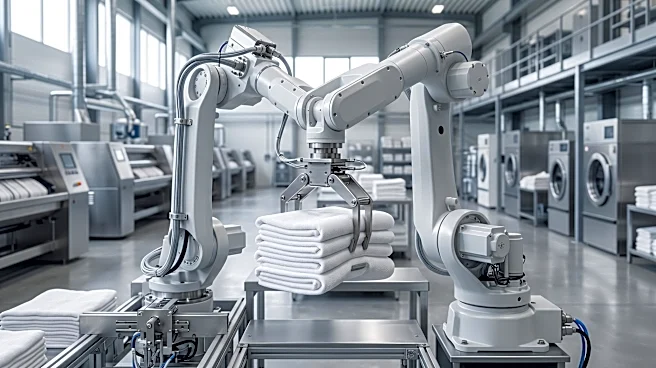
Gobano Robotics, a French physical AI startup, has reported a 99.5% task success rate for its autonomous robotic system at Henri Wartner Group, a French industrial laundry company. The Gobano Station robot is designed to handle repetitive towel folding
and inspection tasks, operating autonomously for several hours. This system achieves 68% of a human worker’s throughput over an 18-hour shift. The robot is engineered to manage variations in towel positioning, fabric folds, and gripping conditions without constant human supervision. Its recovery capability allows it to automatically restart workflows if a grasp fails or a towel is misplaced, ensuring continuous production. Employees are still responsible for replenishing materials, maintenance, and resolving exceptions that the robot cannot handle. The system utilizes Gobano’s Toutatis reinforcement learning engine, which integrates human demonstrations, task-specific world models, and operational experience to continuously improve its performance.
Why It's Important?
This development signifies a notable advancement in the application of autonomous robotics within industrial settings, particularly for tasks involving flexible materials like textiles. The high success rate and autonomous operation demonstrated by Gobano Robotics could lead to increased efficiency and reduced labor costs in industries reliant on repetitive manual tasks. For U.S. businesses, this technology presents a potential solution to labor shortages and a way to optimize production lines, especially in sectors such as hospitality, healthcare, and manufacturing that deal with large volumes of laundry or similar material handling. The emphasis on reliability before speed suggests a practical approach to automation that could encourage wider adoption. The ability of the robot to learn and adapt through reinforcement learning also points to a future where industrial robots become more versatile and less dependent on pre-programmed instructions, potentially transforming the operational models of various U.S. industries.
What's Next?
Gobano Robotics plans to further extend the operating periods of its autonomous laundry robots, increase their throughput, and develop capabilities to handle additional materials and workflows. The company also aims to transfer the learning acquired from existing installations to future robotic systems, which would reduce the time and effort required to establish reliable autonomous operations in new deployments. This suggests a strategic move towards broader commercialization and application of their AI technology across different industrial sectors. For the U.S. market, this could mean the introduction of more sophisticated and adaptable robotic solutions in the coming years, potentially impacting job roles and requiring workforce retraining in industries that adopt such automation. The continued refinement of these systems will likely focus on enhancing their ability to operate in complex, unstructured environments with minimal human intervention.
Beyond the Headlines
The successful deployment of Gobano Robotics' autonomous laundry robot highlights a broader trend in industrial automation: the increasing capability of AI and robotics to handle complex, variable tasks previously thought to require human dexterity and judgment. This development raises ethical and societal questions regarding the future of work, particularly for roles involving repetitive manual labor. While proponents argue that automation frees human workers for higher-value tasks, concerns about job displacement and the need for robust retraining programs will likely grow. Furthermore, the integration of reinforcement learning in industrial robots introduces a new dimension of adaptability, allowing machines to learn from experience and improve over time. This could lead to a significant shift in how manufacturing and service industries operate, potentially creating new economic opportunities while also demanding new regulatory frameworks and societal adjustments to a more automated workforce.