





What's Happening?
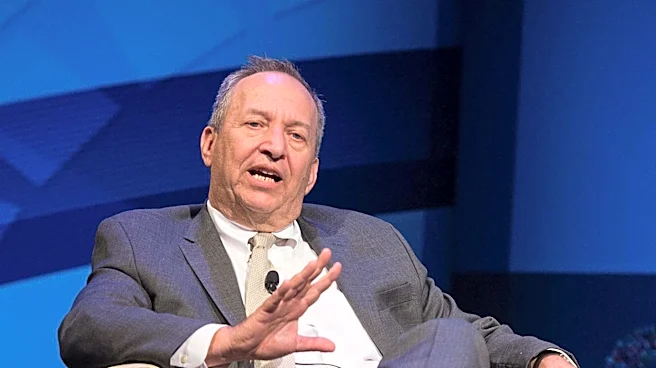
Charlie Munger, in his 2003 lecture titled 'Academic Economics: Strengths and Faults after Considering Interdisciplinary Needs' at the University of California, Santa Barbara, highlighted Larry Summers as an example of an exceptionally intelligent individual
in economics. Munger noted that Summers, along with George Shultz, interacted more with the practical world than was typical for academics in other disciplines. Munger's lecture, delivered without him having taken a formal economics course, argued that his experience at Berkshire Hathaway and a multidisciplinary approach provided valuable economic insights. He contended that economics, despite its strengths, remains deficient due to insufficient integration of fields like psychology, biology, physics, history, and incentives into its models.
Why It's Important?
Munger's commendation of Larry Summers underscores a significant debate within the field of economics regarding the balance between theoretical academic models and practical, real-world application. Summers' background as a former Secretary of the Treasury and director of the National Economic Council exemplifies the kind of practical engagement Munger advocates. This perspective is crucial for U.S. policymakers, business leaders, and economic stakeholders who rely on economic analysis to inform critical decisions. The call for greater interdisciplinary integration in economics suggests that a more comprehensive understanding of complex issues, such as market behavior, policy effectiveness, and societal trends, requires insights from diverse fields. This approach can lead to more robust and effective economic policies and business strategies, benefiting various sectors of the U.S. economy.
What's Next?
The ongoing discussion about the interdisciplinary nature of economics, as championed by figures like Munger, will likely continue to influence academic curricula and research methodologies. Universities and economic think tanks may increasingly emphasize cross-disciplinary studies and collaborations to address complex challenges. For policymakers, this could mean a greater demand for economic advisors who possess not only strong theoretical foundations but also a deep understanding of behavioral science, history, and other relevant fields. Businesses might also seek economists who can provide more holistic insights, moving beyond traditional economic models to inform strategic planning and risk management. This shift could lead to more nuanced and effective approaches to economic problem-solving in the U.S.
Beyond the Headlines
Munger's critique of academic economics, despite its strengths, points to a deeper philosophical challenge within the social sciences: the pursuit of elegant, simplified models versus the messy complexity of reality. By praising Larry Summers' practical engagement, Munger implicitly advocates for an epistemology that values empirical observation and multidisciplinary synthesis over purely theoretical constructs. This has profound implications for how economic 'truth' is established and applied, particularly in a dynamic and interconnected global economy. The call for integrating psychology, biology, and history into economic models suggests a move towards a more human-centric and context-aware understanding of economic phenomena. This could lead to more ethical and socially responsible economic policies, as it encourages a consideration of human behavior and societal well-being beyond purely financial metrics, fostering a more resilient and equitable economic system in the U.S.