







What's Happening?
Granite (NYSE: GVA) announced the completion of two strategic acquisitions on November 13, 2026, aimed at strengthening its market presence in Utah and expanding its platform in West Tennessee. The company acquired Construction Materials Company, LLC
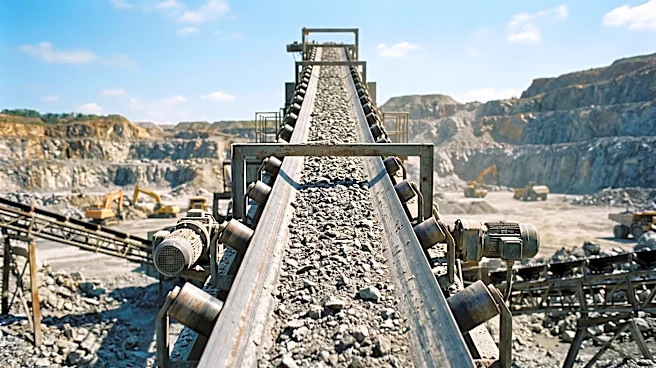
(CMC) in Utah and Ford Construction Company, Camden Gravel, and Choctaw Transportation (collectively 'Ford Construction') in Tennessee. The CMC acquisition enhances Granite's Utah home market by adding an aggregates and ready-mix concrete platform, serving the fast-growing Provo-Orem-Lehi area. This includes three aggregate facilities producing over 2 million tons annually and five ready-mix concrete batch plants. The Ford Construction acquisition expands Granite's Southeast platform in West Tennessee, bringing complementary capabilities in asphalt paving, bridge and marine construction, hot-mix asphalt, sand-and-gravel, transportation, and river-material handling. This addition includes four hot-mix asphalt plants and three sand and gravel sites, with approximately 46 million tons of estimated resources. These acquisitions are part of Granite's strategy to support and strengthen existing home markets while selectively expanding with vertically integrated businesses.
Why It's Important?
These acquisitions are significant for Granite's long-term growth strategy and have broader implications for the U.S. construction and infrastructure sectors. By acquiring CMC, Granite substantially increases its aggregate reserves and extends its vertically integrated footprint in Utah, a region experiencing rapid population and job growth. This move ensures a stable supply of essential construction materials, which is critical for supporting ongoing and future infrastructure projects in the state. The Ford Construction acquisition similarly strengthens Granite's presence in the Southeast, particularly in Tennessee's public infrastructure market, which is supported by funding from the Tennessee Department of Transportation and local municipalities. This expansion enhances Granite's capabilities in key areas like asphalt paving and bridge construction, vital for maintaining and developing transportation networks. For the U.S. economy, these consolidations in the construction materials sector can lead to greater efficiency and potentially more competitive pricing for large-scale infrastructure projects, benefiting taxpayers and accelerating development timelines. It also signals a trend of strategic vertical integration within the industry to secure supply chains and optimize operational synergies.
What's Next?
Granite anticipates that these acquisitions will generate significant financial benefits. CMC is expected to contribute over $75 million in annual revenues in 2027 with an adjusted EBITDA margin in the mid-to-low 20s, while Ford Construction is projected to add approximately $100 million in annual revenue in 2027 with an adjusted EBITDA margin exceeding 20%. The company plans to leverage these new assets to create synergistic opportunities, supplying aggregates and ready-mix concrete to its own projects and third-party customers. Granite's President and CEO, Kyle Larkin, emphasized that these acquisitions will deepen the company's materials platform, broaden its geographic reach, and position it for continued organic growth and long-term value creation. The company's strong cash-flow generation and healthy balance sheet are expected to support further investments and disciplined strategic growth, aiming to generate attractive long-term returns for shareholders. The integration of these new entities will be a key focus, ensuring operational efficiencies and maximizing the strategic fit within Granite's existing operations.
Beyond the Headlines
The strategic moves by Granite reflect a broader trend in the U.S. construction industry towards vertical integration and market consolidation, driven by the increasing demand for infrastructure development and the need for secure supply chains. This approach allows companies to control more aspects of the construction process, from raw materials to project execution, potentially leading to greater cost efficiencies and quality control. However, it also raises questions about market competition and the potential for smaller, independent material suppliers to compete against larger, integrated entities. The acquisitions highlight the critical role of construction materials in national development and the strategic importance of securing access to aggregates and concrete in rapidly growing regions. This trend could influence future regulatory considerations regarding market concentration in the construction sector and the allocation of public funds for infrastructure projects, ensuring a diverse and competitive supplier base. The long-term implications include potential shifts in regional economic power within the construction industry and the resilience of supply chains against economic fluctuations.