
What's Happening?
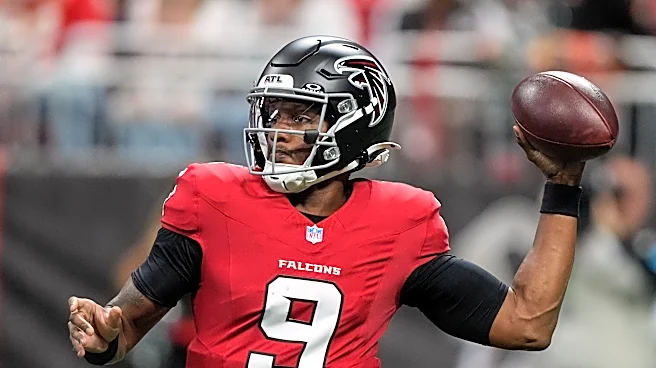
The Atlanta Falcons' offense has experienced a significant downturn in recent weeks, particularly following an initial strong start after quarterback Michael Penix Jr.'s return to the lineup. After averaging
31 points per game during his first five starts, which resulted in a 3-2 record, the team's offensive output has plummeted to an average of just 10 points per game over their last three losses. During this three-game losing streak, Penix Jr. has thrown six interceptions, a notable shift from his earlier performance where he was praised for ball security. The source indicates that Penix Jr. struggles with immobility and becomes flustered under pressure, impacting his ability to see the field and make accurate throws. Offensive coordinator Tommy Rees is also facing criticism for play-calling that some suggest reflects a lack of trust in Penix Jr., with an over-reliance on quick screens. In a recent game against the Chiefs, Penix Jr. completed only 23 of 43 pass attempts (53.4%), with a significant portion of his 286 passing yards coming in the fourth quarter when the team was already trailing by multiple scores. The run game has also faltered, with insufficient utilization of Bijan Robinson, further exacerbating the pressure on Penix Jr.
Why It's Important?
The struggles of the Atlanta Falcons' offense, particularly the performance of Michael Penix Jr. and the play-calling of Tommy Rees, have significant implications for the team's season trajectory and future strategic decisions. For the Falcons, a continued decline in offensive production could jeopardize their playoff aspirations and impact fan engagement and revenue. The performance of a high-draft-pick quarterback like Penix Jr. is crucial for franchise stability; if his struggles persist, it could lead to questions about his long-term viability as a franchise quarterback, potentially forcing the team to re-evaluate its quarterback strategy in upcoming seasons. For offensive coordinator Tommy Rees, his ability to adapt the offense to Penix Jr.'s strengths and improve overall offensive efficiency will be critical for his job security and reputation within the NFL. The situation also highlights the complex dynamic between a young quarterback and an offensive coordinator, where a lack of synergy can undermine the potential of both. The team's investment in offensive talent, including players like Drake London, Kyle Pitts, and Bijan Robinson, is not being fully realized, which could lead to frustration among players and management.
What's Next?
The immediate future for the Atlanta Falcons will likely involve intense scrutiny on both Michael Penix Jr.'s performance and Tommy Rees's play-calling. The coaching staff will need to address the offensive struggles, potentially by adjusting the offensive scheme to better suit Penix Jr.'s capabilities and by finding ways to build his confidence early in games. This could involve a renewed focus on establishing the run game with Bijan Robinson to alleviate pressure on the passing attack. If the offensive struggles continue, there could be calls for changes in coaching personnel or even a re-evaluation of Penix Jr.'s role as the starting quarterback, although such a move would be significant given his draft position. The team's upcoming games will be critical in determining whether they can reverse this negative trend and salvage their season. Stakeholders, including team ownership, management, and fans, will be closely watching for signs of improvement and strategic adjustments to address the current offensive challenges.
Beyond the Headlines
The current situation with the Atlanta Falcons' offense extends beyond immediate game results, touching upon broader themes of player development, coaching philosophy, and the pressures inherent in professional sports. The dynamic between Penix Jr. and Rees illustrates how a lack of effective collaboration and adaptation can hinder even talented individuals. It raises questions about the process of integrating young quarterbacks into complex NFL offenses and the responsibility of coaching staff to foster their growth. The narrative also highlights the intense public and media scrutiny faced by high-profile draft picks and coaching staff, where early struggles can quickly lead to doubts about long-term potential. Ethically, there's a discussion to be had about how much blame should be attributed to a young player still developing versus the coaching staff responsible for putting him in a position to succeed. The long-term implications could influence future draft strategies for other NFL teams, emphasizing the importance of not only raw talent but also the right coaching environment and offensive system for a quarterback's success.