

What's Happening?
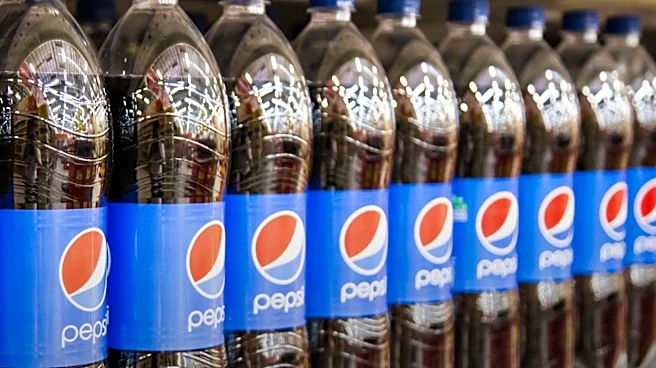
PepsiCo's President and CEO, Ramon Laguarta, has expressed dissatisfaction with the company's performance in the United States, particularly concerning North American soft drinks. This statement was made during the third-quarter earnings call, where organic
revenue growth was reported at 3.1%. The company has also revised its core EPS growth forecast for 2026 downwards, from a previous range of 5%-7% to 2.5%-3.5%. Following these developments, Bernstein downgraded PepsiCo's stock from Market Perform to Underperform on November 17, citing anticipated missed earnings due to declining North American volumes. Laguarta indicated that PepsiCo is 'looking at everything,' including a potential spin-off, to address these challenges and improve free cash flow growth, which has remained stagnant between $7.62 billion in fiscal year 2016 and $7.67 billion in fiscal year 2025, while dividends paid increased significantly.
Why It's Important?
The underperformance of PepsiCo's North American beverage segment and the subsequent reduction in its EPS growth forecast signal potential headwinds for the company's financial outlook and investor confidence. For U.S. consumers, this could lead to strategic shifts in product offerings or marketing efforts as PepsiCo seeks to revitalize its domestic market. For investors, particularly those focused on dividend income, the stagnation in free cash flow growth alongside rising dividend payouts raises concerns about the sustainability of future dividend increases. The payout ratio reached 99.6% in fiscal year 2025, indicating that nearly all free cash flow was used for dividends. A potential spin-off, as mentioned by Laguarta, could significantly restructure the company, impacting its competitive landscape and market valuation. The downgrade by Bernstein further underscores the financial community's apprehension regarding PepsiCo's near-term earnings potential.
What's Next?
PepsiCo is actively exploring various strategies to address its performance issues, including a potential spin-off, as stated by CEO Ramon Laguarta. The company's ability to reignite free cash flow growth will be critical in maintaining its dividend growth trajectory and investor appeal. If free cash flow remains stagnant while dividends continue to rise, the payout ratio could approach 100%, which would necessitate a reevaluation of its dividend policy. Investors will closely monitor future earnings calls for updates on strategic initiatives and any potential restructuring announcements. The market will also be watching for signs of improvement in North American beverage volumes and overall organic revenue growth to assess the effectiveness of PepsiCo's corrective measures.
Beyond the Headlines
The challenges faced by PepsiCo in its North American beverage segment highlight broader shifts in consumer preferences and the competitive landscape within the U.S. food and beverage industry. The stagnation of free cash flow despite increasing dividends points to a potential disconnect between shareholder returns and underlying business performance, a common issue for mature companies. The consideration of a spin-off suggests a strategic re-evaluation of PepsiCo's diverse portfolio, potentially leading to a more focused business model. This could set a precedent for other large conglomerates facing similar pressures to streamline operations and unlock shareholder value. The situation also underscores the importance of innovation and adaptability in a rapidly evolving market where consumer tastes are increasingly shifting towards healthier or alternative beverage options.