





What's Happening?
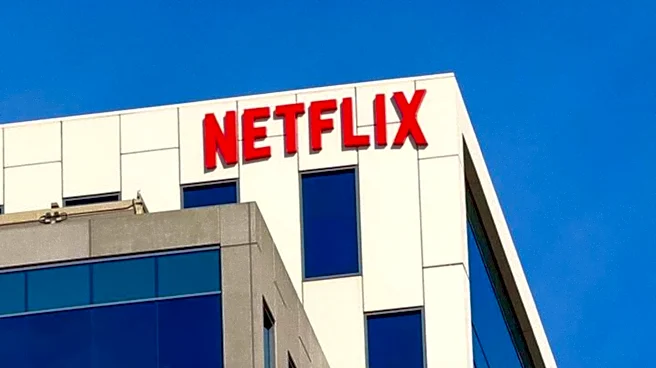
Netflix is re-evaluating its strategy for expanding 'Netflix Houses,' its year-round fan destinations located in shopping malls, due to the underperformance of its initial two locations. The streaming giant launched its first Netflix House in Philadelphia,
followed by another in Texas a month later. These venues are designed to offer immersive experiences, shopping, dining, and games themed around popular Netflix shows like 'Stranger Things,' 'Squid Game,' 'Wednesday,' and 'One Piece.' Admission tickets start at $39, with attractions including themed mini-golf and virtual reality games. However, sources familiar with the initiative indicate that the Dallas location is only just breaking even, while the King of Prussia, Pennsylvania, Netflix House is struggling with low late-night traffic. Despite these challenges, a third location in Las Vegas is already under development, with completion expected in 2027. This Vegas site, a smaller venue in a more urban setting, is being considered as a potential model for future Netflix House plans. Co-CEO Ted Sarandos and co-founder Reed Hastings, who initially supported aggressive expansion, are now pausing plans for new locations for approximately a year.
Why It's Important?
The reassessment of Netflix House expansion plans highlights the challenges traditional entertainment companies face when venturing into physical retail and experiential spaces. This move could signal a broader caution within the entertainment industry regarding large-scale, capital-intensive physical ventures, especially in a post-pandemic retail landscape. For Netflix, a company primarily known for its digital streaming service, the struggle of these physical locations indicates that translating online brand loyalty into profitable in-person experiences is more complex than anticipated. The mixed reviews from visitors, citing average food and mid-level experiences, suggest that the value proposition may not be strong enough to drive consistent traffic, particularly during off-peak hours. This situation could influence how other streaming platforms or digital-first brands approach diversifying their revenue streams and engaging with their audience beyond screens. The performance of the Las Vegas location will be crucial in determining the viability of future, potentially more targeted, physical entertainment concepts.
What's Next?
Netflix is expected to closely monitor the performance of its existing Netflix Houses, particularly the upcoming Las Vegas location, over the next year. The pause in expansion plans suggests a period of strategic re-evaluation, where the company will likely analyze visitor data, feedback, and operational costs to refine its physical entertainment model. Future decisions on expansion will likely hinge on whether the Las Vegas site, with its smaller footprint and urban setting, proves to be a more successful and sustainable model. Netflix may explore adjustments to pricing, attraction offerings, and marketing strategies to improve visitor engagement and profitability. The company might also consider different types of physical activations, such as pop-up experiences or collaborations, rather than large, permanent venues. The outcome of this reassessment could influence Netflix's long-term strategy for diversifying its business beyond streaming and its approach to leveraging its intellectual property in experiential ways.
Beyond the Headlines
The struggles of Netflix Houses underscore a broader trend in the entertainment and retail sectors: the evolving nature of consumer engagement and the difficulty of creating compelling 'destination' experiences. In an era dominated by digital consumption, consumers have high expectations for immersive, unique, and value-driven physical experiences. The mixed reception of Netflix Houses suggests that simply leveraging popular intellectual property may not be sufficient; the execution, quality of offerings, and overall value proposition are critical. This situation also reflects the ongoing challenges faced by traditional shopping malls, which are seeking innovative tenants to attract foot traffic. For Netflix, a company built on data-driven decisions, the performance of these physical locations will provide valuable insights into the limits and opportunities of brand extension into the physical realm. It raises questions about whether the future of entertainment lies in purely digital spaces or if a hybrid model can truly thrive, and what elements are essential for success in the latter.