






What's Happening?
Nvidia has showcased its new RTX Spark platform, highlighting its capabilities across local AI development, content creation, and gaming on slim, Arm-based Windows laptops. The platform integrates Nvidia's Blackwell architecture and Grace CPU with a substantial
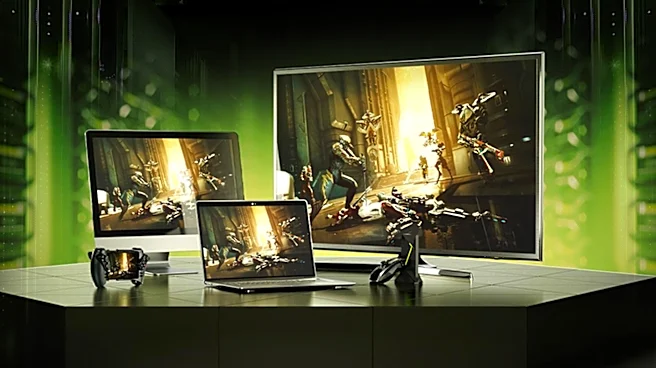
unified memory pool, reaching up to 128GB. During a demonstration, the RTX Spark, specifically a Dell XPS 16 Creator Edition laptop equipped with a 20 Core Nvidia Grace CPU and a 6,144-core Blackwell RTX GPU, ran the game Marvel Rivals at over 180 frames per second (fps). This performance was achieved using DLSS Quality preset and 6x Multi Frame Generation, with graphics settings set to their lowest. Nvidia is actively collaborating with publishers and anti-cheat developers to enhance game compatibility on Arm-based Windows platforms, announcing support for titles like Fortnite, Counter-Strike 2, ARC Raiders, and Marvel Rivals. Beyond gaming, RTX Spark is designed to handle demanding tasks such as 8K 4:2:2 video editing and rendering large 3D scenes up to 90GB, leveraging its unified memory for content creators and AI agents.
Why It's Important?
The introduction of Nvidia's RTX Spark platform signifies a pivotal moment for Arm-based Windows laptops, potentially bridging the performance gap with traditional x86 systems in demanding applications like gaming and AI. The platform's focus on local AI development and deployment could empower developers with greater control over data and reduce reliance on cloud inference fees, fostering innovation in AI agents. For content creators, the ability to handle intensive tasks like 8K video editing and large 3D renders on a slim laptop could revolutionize mobile workstations. While gaming performance, particularly with DLSS and frame generation, shows promise, the underlying Arm architecture still faces challenges in native game compatibility and consistent frame delivery. This development could accelerate the adoption of Arm-based systems in professional and enthusiast markets, challenging the dominance of Intel and AMD in certain segments and driving further competition in the laptop industry.
What's Next?
Nvidia is expected to continue its efforts in expanding game compatibility and optimizing performance for the RTX Spark platform on Arm-based Windows. Further collaborations with game publishers and anti-cheat developers will be crucial for broader adoption in the gaming community. As the platform matures, more applications and AI models are likely to be optimized to leverage its unified memory and processing power. Consumers can anticipate a new generation of slim, powerful laptops that cater to AI developers, content creators, and gamers, offering a compelling alternative to existing solutions. The long-term success of RTX Spark will depend on its ability to deliver consistent performance across a wide range of software and to overcome the current limitations of Arm-based gaming, such as input latency and frame consistency.
Beyond the Headlines
The emergence of platforms like Nvidia's RTX Spark represents a significant shift in the computing landscape, blurring the lines between traditional CPU and GPU roles through unified memory architectures. This integration could lead to more efficient and powerful mobile devices, fundamentally changing how users interact with AI and demanding applications on the go. The emphasis on local AI processing also raises important discussions about data privacy and security, as more computational tasks can be performed on-device rather than in the cloud. Furthermore, the push for Arm-based Windows systems could foster a more diverse and competitive ecosystem in the PC market, potentially leading to more innovative hardware designs and energy-efficient solutions. However, the challenge of ensuring seamless software compatibility and optimizing performance for a new architecture remains a critical hurdle for widespread adoption.